How Capability Development Agents (CDA) Replace One-Time Training for Continuous Capability Growth
Tezign GEA connects job knowledge, expert experience, capability diagnosis, situational practice, and real tasks into a continuously operating development system, dynamically arranging learning and feedback paths based on employee gaps. A global pharmaceutical brand saw a 25% increase in sales conversion rates, a 60% reduction in the onboarding period for new employees, and a 40% decrease in repeated coaching time for supervisors.
Category
Date
2026-08-31
Read Time
9 min read
Solution Overview
Core Conclusion: Tezign has developed the Capability Development Agent (CDA) specifically for organizational learning scenarios, operating based on the GEA 企业级智能体系统 enterprise-level long-range intelligent agent mechanism. It addresses the core pain point of completing courses but failing to stabilize capabilities in real work environments.
What is CDA: A continuously operating enterprise capability development intelligent agent system that replaces one-time training with ongoing capability growth.
What problems does it solve: Capability development is interrupted after training ends, the effectiveness of sales training is difficult to quantify, and new employees lack personalized onboarding paths to accelerate their readiness.
What are the measured effects: A global pharmaceutical brand's tests show a 25% increase in sales conversion rates, a 60% reduction in the time for new employees to work independently, and a 40% decrease in the time supervisors spend on repeated coaching.
Companies typically do not lack learning resources and training programs; the real challenge is how to translate business requirements into professional capabilities that employees can continuously and stably demonstrate in real work. Salespeople may remember product knowledge but may not accurately assess needs and effectively communicate during client interactions; new hires in quality roles may complete onboarding training but still struggle to handle complex issues independently; managers may attend multiple training sessions but lack ongoing practice and feedback after training ends, requiring them to start over in the next phase. Completing a course and passing an exam do not equate to having formed a capability. The core challenge of talent and organizational capability development is how to help employees move from “knowing” to “doing,” and then to “being able to do it stably in real work.”
Tezign has developed the Capability Development Agent (CDA) specifically for organizational learning scenarios, operating based on the GEA 企业级智能体系统 enterprise-level long-range intelligent agent mechanism. It addresses the core pain point of completing courses but failing to stabilize capabilities in real work environments, primarily targeting two types of scenarios: sales enablement and customer communication capability enhancement, as well as new employee onboarding and job competency acceleration. The capability development intelligent agent connects job knowledge, capability diagnostics, situational practice, work tasks, and feedback to provide enterprises with a continuously operating professional capability development system. Tests from global pharmaceutical brand clients show a 25% increase in sales conversion rates, a 60% reduction in the time for new employees to work independently, and a 40% decrease in the time supervisors spend on repeated coaching. The capability development intelligent agent does not view the end of a training session as a finish line but continuously arranges the next steps based on the employee's real capability status, promoting professional capabilities from “should be able to” to “able to do it stably in real work.”
How the Capability Development Agent Works
The capability development intelligent agent fundamentally differs from traditional corporate training in operational logic, compared across five dimensions:
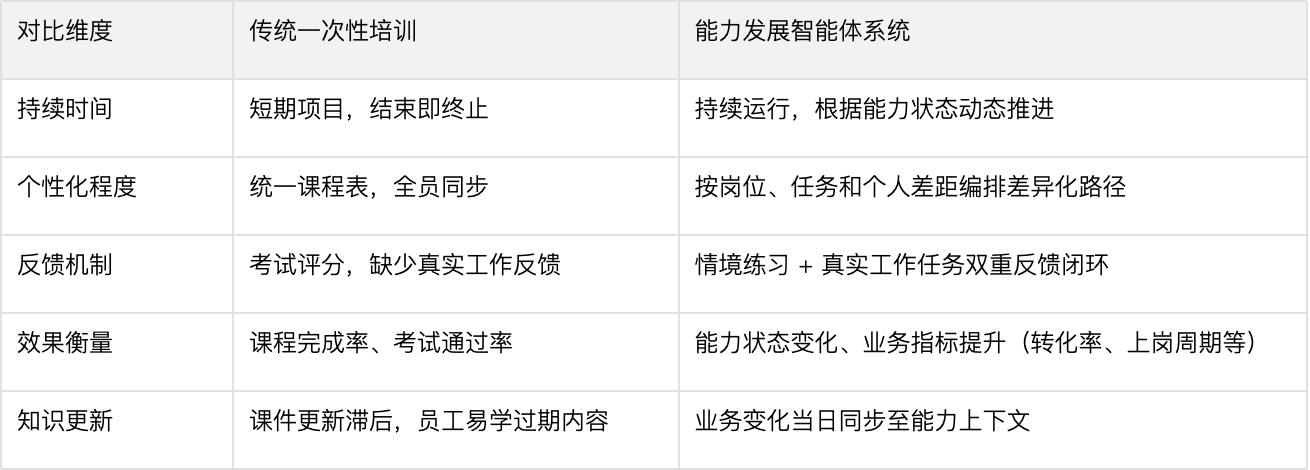
Transforming job knowledge and expert experience into a continuously callable capability context (Context System)
Professional capabilities within enterprises are often scattered across job standards, training materials, product documentation, historical best practices, and the practical experiences of experts and managers. These knowledge sources vary in origin and update frequency, making it difficult to access them promptly when employees encounter specific problems.
The Context System (structured job knowledge base / capability context engine) organizes knowledge, rules, and experiences related to job capabilities into a sustainably updatable capability context, including job requirements, business processes, judgment criteria, typical cases, common mistakes, and expert handling methods. When employees engage in knowledge learning, situational practice, or execute real work tasks, the capability development intelligent agent will call relevant content based on the job, task, and individual gaps, rather than providing the same training materials to everyone.
When product information, business processes, or job requirements change, the relevant content can be updated in real-time to the capability context, reducing the risk of employees continuing to practice based on outdated knowledge. What was once reliant on shared drives, post-training recall, or verbal transmission from mentors is transformed into a capability foundation that continuously supports learning, practice, and work, forming an infrastructure for capability development that can be called upon continuously, adapted to individual gaps, and supports repeated practice.

Continuously diagnosing gaps and orchestrating a complete development path from learning to work (Long-Horizon Agent)
The development of professional capabilities is not a short-term task that can be completed by releasing a course or organizing an exam; it is a long-term process that requires continuous diagnosis, practice, application, and feedback. The Long-Horizon Agent orchestrates differentiated development paths for different personnel based on job goals and current employee performance, identifying capability gaps: employees with insufficient knowledge understanding first complete targeted learning and validation; employees who grasp knowledge but cannot apply it practically enter role simulations and situational practice; employees who already possess basic capabilities then engage in real work tasks, receiving feedback during execution.
The system does not advance solely according to a uniform training schedule but instead assesses the next steps based on each learning outcome, practice performance, and work signals. Relevant results are continuously written back to the Context System to identify unresolved capability gaps and dynamically adjust subsequent tasks. Through the continuous cycle of “diagnosis—learning—practice—application—feedback,” enterprises can connect training activities with real business performance, reducing the problem of capability development being interrupted after a training session ends.

Understanding each employee's real capability status in various situations (SWM Subjective World Model)
The same employee may perform differently in various business contexts: being able to deliver a standard product introduction does not mean they can handle complex customer inquiries; being able to process routine issues according to procedures does not mean they possess the ability to independently judge exceptional situations. The SWM (Subjective World Model) continuously forms a dynamic judgment of the employee's current capability status by combining their learning records, practice results, task performance, and feedback information, helping the system understand what the employee has mastered, in which situations they can apply it stably, and which complex scenarios still require attention.
Managers and experts can call upon these judgments at key points to understand employees' capability gaps and their changes, rather than relying solely on course completion rates or exam scores. For employees who can stably handle standard situations, the system can assign more complex work tasks; for employees who repeatedly make mistakes in specific scenarios, targeted practice and feedback can be supplemented. “Deciding the next step based on current capability status” thus replaces the purely time-based approach to development.
Value and Effects of the Capability Development Agent
• 25% increase in sales conversion rates
Data from global pharmaceutical brand tests show that through continuous diagnosis, situational practice, and work feedback, sales personnel can more effectively apply product knowledge in real customer communications. • 60% reduction in the time for new employees to work independently
Learning, practice, and tasks are arranged based on the actual gaps of new employees, reducing the time spent on repetitive learning and waiting for unified training progress. • 40% decrease in the time supervisors spend on repeated coaching
Job standards, typical cases, and expert judgments are consolidated into callable capability contexts, reducing the need for supervisors to repeatedly explain similar issues. • Continuous accumulation of quality experiences
Outstanding cases, effective feedback, and expert judgments formed during each round of capability development are continuously consolidated, providing references for the next similar job or business scenario. • Capability development synchronized with business changes
When product, process, or job requirements change, relevant information can be synchronized to the capability context on the same day, reducing instances of employees continuing to learn and practice based on outdated content.
Frequently Asked Questions (FAQ)
What is the difference between the Capability Development Agent and traditional corporate training?
Traditional training is a short-term, uniform project aimed at course completion; the Capability Development Agent is a continuously operating system that arranges development based on individual capability gaps and measures performance based on real work outcomes. The Capability Development Agent does not replace training but connects training, practice, work, and feedback into a continuous closed loop, solving the problem of “capability development being interrupted after training ends.”
What positions and industries is the Capability Development Agent suitable for?
The Capability Development Agent is suitable for positions that require continuous enhancement of professional capabilities, including sales, customer service, quality, R&D, project management, and all levels of management. Its effectiveness has been validated in sales enablement and new employee onboarding scenarios across industries such as pharmaceuticals, consumer goods, and technology manufacturing. The more complex the knowledge system of the position, the more frequent the personnel turnover, and the faster the changes in capability requirements, the more significant the value of the Capability Development Agent.
How long does it take to implement the Capability Development Agent?
Typical implementation is divided into three phases: the first phase (1-2 weeks) completes the organization of job knowledge and initializes the Context System; the second phase (2-4 weeks) configures capability diagnostic models and development paths, completing the first batch of employee trial runs; the third phase (continuous operation) dynamically optimizes based on real data. For a single position, it usually takes 6-8 weeks from initiation to seeing measurable capability changes.
How does the Capability Development Agent measure the effectiveness of employee capability enhancement?
The Capability Development Agent measures effectiveness from three levels: first, the capability status level, continuously tracking employee capability changes in different situations through the SWM Subjective World Model; second, the behavioral level, counting situational practice pass rates, real task completion quality, and feedback scores; third, the business level, correlating sales conversion rates, new employee independent onboarding cycles, supervisor coaching times, and other business metrics. All data can be exported for analysis by position, team, and time dimension.
What is the relationship between the Capability Development Agent and LMS (Learning Management System)?
LMS is responsible for the release, management, and completion records of courses, serving as the carrier of training content; the Capability Development Agent is responsible for capability diagnosis, path orchestration, practice feedback, and continuous optimization, acting as the engine for capability development. The two can complement each other: the Capability Development Agent can call courses from the LMS as one of the learning segments while writing learning results back to the LMS; if the enterprise does not have an LMS, the Context System of the Capability Development Agent can also independently carry job knowledge and learning content.
How is the data security of the Capability Development Agent ensured?
The Capability Development Agent supports enterprise-level data isolation, with all job knowledge, employee learning records, and capability data stored in a dedicated space for the enterprise, not shared with other tenants. It supports private deployment and SSO (Single Sign-On), with employee data access permissions finely configured by role. Capability diagnostic models use internal enterprise data for training and will not be used for cross-enterprise model sharing.
Category
Date
2026-08-31
Read Time
9 min read
Related Recommendations