Manufacturing
From Post-Verification to Endogenous Constraints, How GEA Reconstructs the Compliance Norms of This Industrial Brand's Production
Tezign's GEA Long-Range Intelligent Agent embeds compliance into the entire production chain of industrial materials, achieving generation-compliance through frameworks and models, freeing up human resources for auditing, improving efficiency and compliance rates, and solidifying the company's proprietary content knowledge assets.
Category
Manufacturing
Date
2026-08-31
Read Time
5 min read
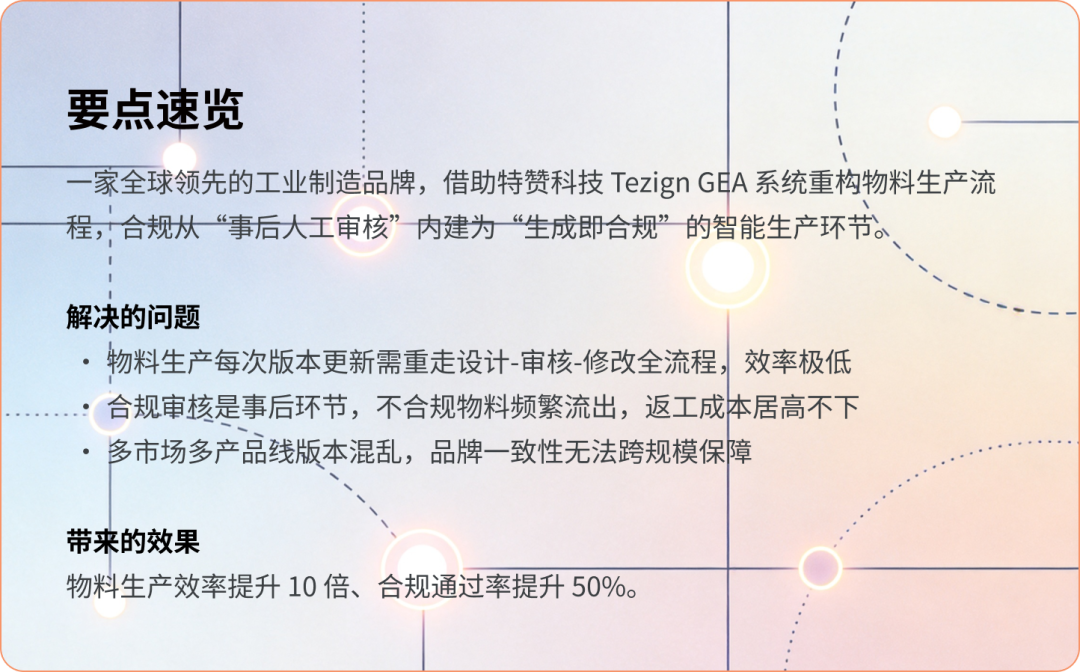
In the field of industrial manufacturing, a leading global brand's materials team has long faced a question: how much of what is produced can actually be used?
Their product lines span multiple markets, with each SKU having different compliance requirements in different countries. Rule enforcement relies on people verifying each item against a checklist, only to discover at the end that the font size is incorrect, warning labels are missing, or color ranges exceed standards—resulting in rework, rescheduling, and re-auditing. Compliance has been treated as a quality inspection step, rather than a part of the production process. As they enter more markets, the demand for materials grows exponentially, and this logic begins to fail completely: judgment standards drift, version management becomes chaotic, and the cost of recalls far exceeds that of rework.
From design to delivery, compliance has always been an add-on, rather than built-in. The starting point of this collaboration is not to discuss what tools to use, but to redefine the role of compliance in material production—it should occur at the moment of generation, not wait until the auditing phase to intervene.
Tezign Technology has created a GEA content growth long-range intelligent agent for this enterprise. It is not a one-time generation tool, but a partner that continuously operates within the enterprise's content production chain—accumulating context across tasks, calling upon existing company knowledge at each decision node to make judgments, and then writing the results back to the system for future use. The entire system is built on the Harness framework, continuously iterating and self-evolving.
Embedding Compliance in Production Changes the Meaning of Auditing
GEA has defined specific nodes for intervening in the material production chain through the Harness framework—validating compliance elements at the time of generation, unifying rule calls during version management, and writing correction results back to the system after auditing. The integration of these three nodes transforms compliance from a post-check into an embedded logic throughout the entire production process.
1. Rules Transition from Post-Review to Built-In Constraints at Generation
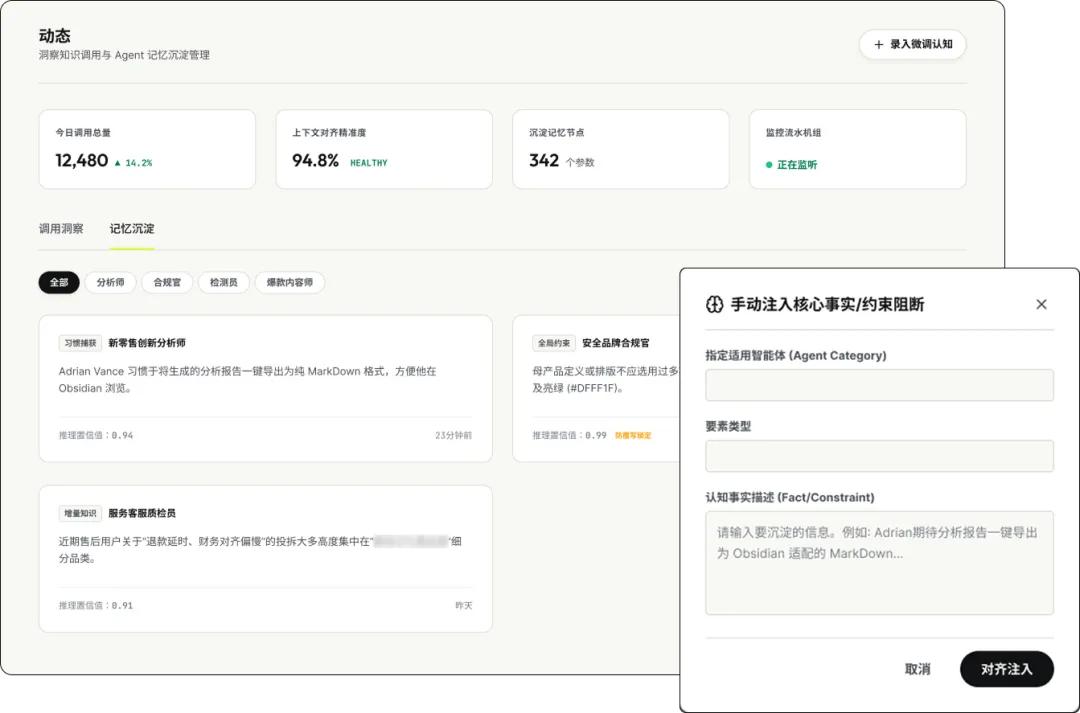
The brand has unified the compliance rules of various markets, brand visual standards, and historical material assets into a structured Context System. Context System carries the compliance rules and historical material assets of each market, writing back results after each execution. It is not a static document library, but a growing enterprise knowledge base that evolves with each project—each execution is not isolated, but helps the system understand this brand better.
The system calls structured compliance rules during material generation, with wording for warning labels, certification marks, and font size requirements being verified in real-time during the generation process. Compliance has moved from the last gate to the starting point of material generation.

2. Cross-Market Versions Managed by the System
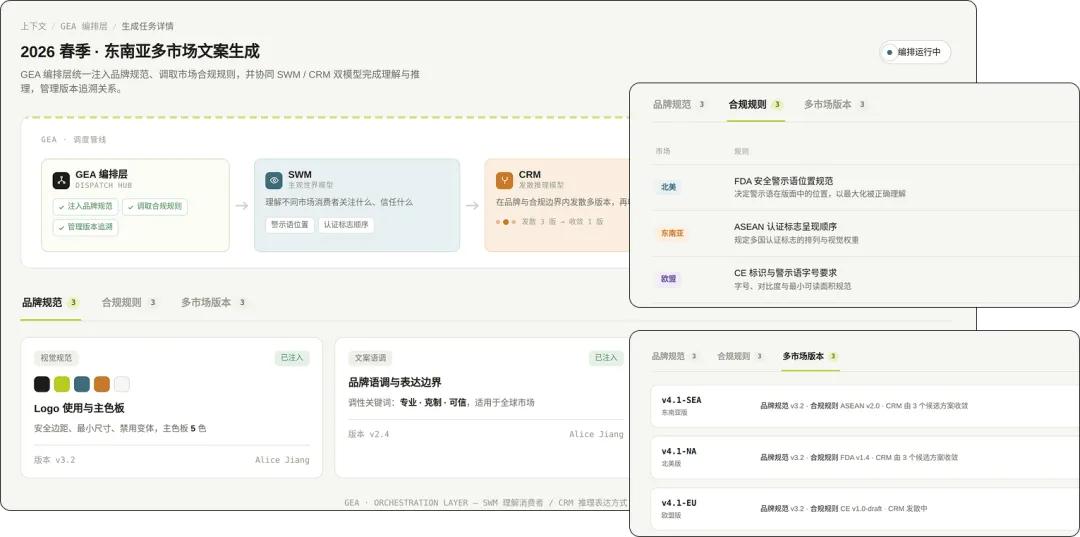
GEA's orchestration layer serves as the scheduling hub, synchronously executing three tasks during generation: injecting brand visual standards, retrieving corresponding market compliance rules, and managing version traceability. It orchestrates two models working in tandem—SWM is responsible for understanding consumers, while CRM handles reasoning about expression methods. SWM (Subjective World Model) understands consumers in different markets: what they care about, what they trust. For example, where to place safety warning labels for maximum reassurance, and the most persuasive order for presenting certification marks. To it, compliance is not just about 'meeting rules,' but also about 'being correctly understood by users.'
CRM (Creative Reasoning Model) builds on SWM's understanding to reason the best expression methods for the same product in different markets. The brand standards and compliance rules already injected into GEA form the boundary of constraints, within which CRM generates multiple versions—such as differing preferences for wording and format between North American and Southeast Asian consumers—before converging on the most suitable one.
Version differences have shifted from relying on human memory for comparison to structured management maintained by the system. Once new compliance requirements are entered, they automatically take effect in the next generation task.
3. Auditing Team Shifts to Rule Architecture Maintenance
The compliance auditing team no longer checks each material one by one but shifts to maintaining the rule set: entering new regulatory requirements, verifying the system's understanding of the rules, and handling boundary cases. From item-by-item judgment to the design and maintenance of rule architecture—the system takes over check actions that can be structured, allowing people to make more valuable judgments.
Efficiency Increased by 10 Times, Compliance Rate Improved by 50%
The increase in efficiency comes from eliminating ineffective cycles, rather than accelerating existing processes. Material production no longer repeatedly goes through 'generation—auditing—problem discovery—rework'; each output can be used directly or lightly reviewed before use. The improvement in compliance rates comes from issues being resolved before auditing, rather than auditing becoming more lenient.
After this system is operational, the brand has accumulated an asset it previously did not have: a reusable compliance rule knowledge base. When entering new markets, new compliance requirements can be structured and entered without having to establish an auditing process from scratch. Each new market challenge helps the system better understand this brand's cross-market operational logic.
As the system continues to operate, every execution result in topic decision-making, creative generation, multilingual adaptation, and channel distribution will be written back, further deepening this brand's proprietary intelligence—its understanding of its users, markets, and content patterns will become increasingly accurate and faster with each collaboration.
The knowledge accumulated by the enterprise no longer exists solely in human experience but is embedded in a system that can be continuously called upon and iterated. This is what truly begins to happen after compliance issues are resolved.
Category
Manufacturing
Date
2026-08-31
Read Time
5 min read
Related Recommendations

Growth of New Energy Vehicle Content: Using AI to Clarify What Users Really Care About

Passenger Vehicle Brand Marketing Growth: Extending Headquarters Content Capabilities to Every Endpoint