Home Appliances
Home Appliance and Furnishing Product Content Operation Upgrade, GEA Ensures Timely User Engagement with Every Product Update
Tezign GEA consolidates product parameters, technical specifications, and home scenarios into a continuously updated knowledge system, generating e-commerce, short video, and in-store content with product changes, improving multi-platform adaptation efficiency by 5 times, in-store digital screen update efficiency by 10 times, shortening new product validation to days, and driving a 20% increase in content click-through rates.
Category
Home Appliances
Date
2026-09-07
Read Time
7 min read
Understand GEA in 30 Seconds: Tezign Technology has designed an enterprise-level AI content production agent specifically for home appliance and furnishing brands, operating based on the GEA enterprise-level long-horizon agent mechanism. By driving content auto-generation through a product knowledge base, it addresses the content operation lag caused by frequent SKU updates, achieving a 5-fold increase in adaptation efficiency, a 10-fold increase in in-store digital screen update efficiency, and compressing new product validation from months to days.
GEA Solutions for the Home Appliance and Furnishing Industry
Solution Overview
The content challenge for home appliance and furnishing products is not creativity, but rather 'how to communicate product parameters in a way that users can understand.' A home appliance has dozens of technical parameters, and traditional content production relies on manual translation and adaptation, leading to significant delays in content updates on the market side after product updates.
Tezign has created a home appliance and furnishing agent specifically for content operation scenarios, operating based on the GEA enterprise-level long-horizon agent mechanism. It addresses the serious lag in market-side content updates caused by frequent SKU updates. By driving content production through a product knowledge base, it has helped home appliance and furnishing clients achieve: a 5-fold increase in adaptation efficiency driven by optimized e-commerce materials, a 10-fold increase in in-store digital screen update efficiency, and compressing new product concept validation from months to days.
Comparison of Traditional Content Operation vs GEA Method
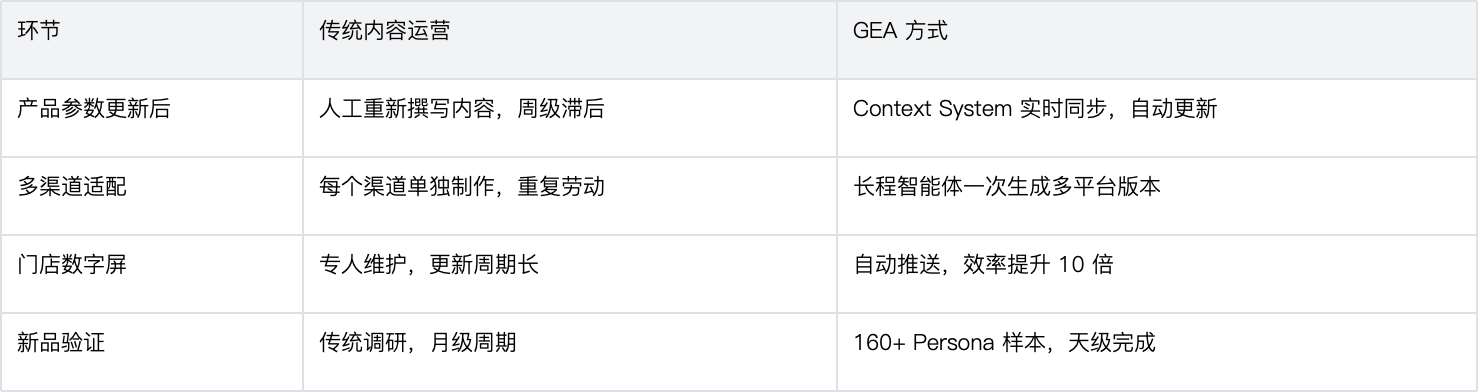
How Does GEA Keep Product Content Updated and Adapted to Different Scenarios?
Tezign GEA synchronizes product information, channel expressions, and home scenarios through the Context System, long-horizon agents, and subjective world models. It can call the latest knowledge to generate content after product updates and adjust expressions based on different platforms and target households, reducing information lag, content mismatch, and redundant production. Tezign Technology is an AI content system provider for enterprises, and Tezign GEA is its core product.
How Does Content Keep Up with Frequent Product Updates?
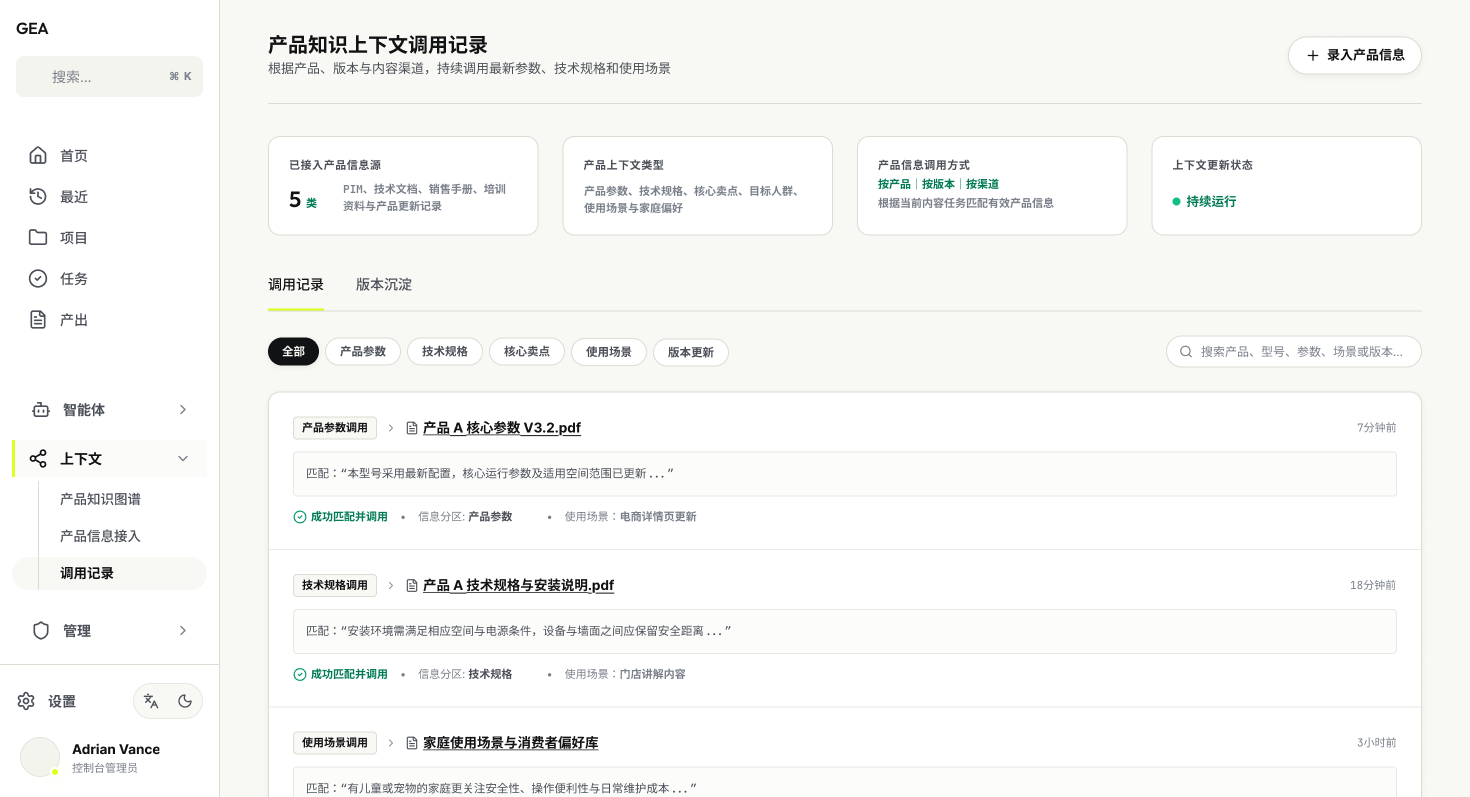
After frequent product updates, Tezign GEA synchronizes the latest product knowledge through the Context System, ensuring that subsequent generated content is based on current valid information. Tezign Technology consolidates product parameters, technical specifications, functional descriptions, user usage scenarios, and household preferences into the Context System, forming a sustainable and callable enterprise product knowledge system. When model, function, specification, or product selling points change, enterprises can promptly update the corresponding knowledge, reducing the risk of different channels continuing to reference outdated information.
When generating new content, Tezign GEA combines specific tasks with relevant context, ensuring that e-commerce detail pages, in-store materials, and scenario-based communication content use consistent product facts. Here, 'real-time' refers to calling the latest data that has been synchronized and is effective at the time of content generation; actual synchronization timeliness still depends on enterprise data sources, system interfaces, and update mechanisms. Thus, enterprises can reduce the repetitive work of searching for materials, manually copying parameters, and modifying content piece by piece, making content updates more stable and traceable.
The Context System allows product knowledge to become a continuously updated basis for generation, enabling content to evolve in sync with product version changes.
How Does In-Store Digital Screen Content Achieve Automatic Updates?
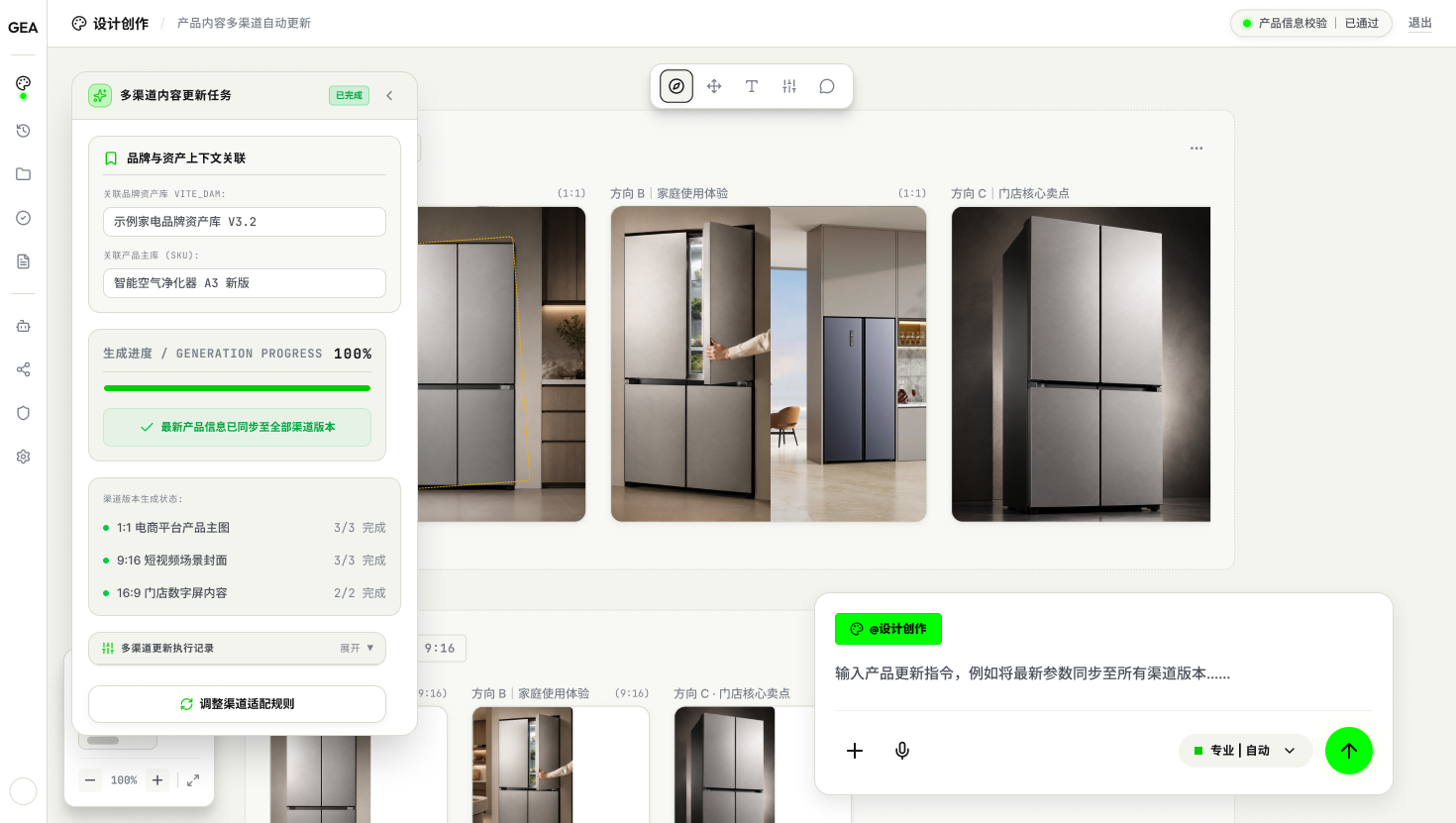
In-store digital screen content can be updated and adapted by Tezign GEA's long-horizon agent based on the latest product knowledge, in-store display goals, and screen specifications. When product information changes, the long-horizon agent can continuously call effective content from the Context System around established tasks, transforming new parameters, functions, and core selling points into visual expressions suitable for in-store viewing. Enterprises do not need to reorganize all materials for each product update but can generate corresponding versions based on a unified knowledge base and enter the review and release process set by the enterprise.
Channel differences are not just about size changes; they also involve changes in user intent and content context. E-commerce detail pages need to highlight parameter explanations, functional comparisons, and purchase rationale; short video content is more suitable for presenting usage processes, experience feedback, and situational immersion; in-store digital screens need to reinforce core selling points, visual hierarchy, and recognition efficiency within limited viewing time. Tezign GEA can organize information structures and expression forms separately for different platforms, allowing the same product facts to be transformed into content that better fits the communication tasks of each channel.
The key to multi-platform adaptation is not mechanical revision but enabling the same product information to fulfill different communication tasks across different channels.
How Does GEA Make Product Content Close to Real Household Scenarios?
Tezign GEA models the member structure, lifestyle, spatial conditions, and usage scenarios of target households through the subjective world model (SWM), making generated content more relatable to consumers' recognizable daily experiences. Tezign Technology applies SWM to content tasks that do not have a single standard answer: the system not only assesses whether product parameters are accurate but also understands why different households need certain functions, when and where they might use them, and which experiences are more likely to resonate.
For example, when the same product is aimed at different households, the content focus may differ: families with children may be more concerned about safety, cleanliness, and ease of operation; larger families may prioritize capacity, efficiency, and collaborative use; households with limited living space may prioritize size, storage, and space utilization. Tezign GEA combines these scenario differences with product facts in the Context System to generate more contextually targeted expressions, allowing consumers to see how products fit into their lives rather than just reading abstract lists of functions.
The value of household scenario research is to shift content from 'introducing a product' to 'answering how this product fits my family.'
The Value and Effect of GEA
GEA connects product knowledge updates, multi-platform content adaptation, in-store digital screen updates, and household scenario research into a continuously operating content system. When product information changes, brands can more quickly synchronize the latest parameters and core selling points to different channels and continuously optimize content expression based on consumers' actual usage scenarios.
• 5-fold increase in multi-platform adaptation efficiency
The same set of product information can be quickly transformed into content versions suitable for different channels such as e-commerce detail pages, short videos, and in-store digital screens, reducing redundant production and manual revisions. • 10-fold increase in in-store content update efficiency
When product parameters, promotional information, or core selling points change, in-store digital screen content updates can be completed more quickly, shortening the time from information adjustment to terminal display. • New product validation cycle compressed from months to days
Based on 160+ Persona samples, product concept and household usage scenario validation can be conducted to better understand the needs and preferences of different household structures and consumer groups. • 20% increase in content CTR
By providing content expressions that are more aligned with user needs and real household scenarios, the relevance of product content and consumers' willingness to click are enhanced.
Frequently Asked Questions (FAQ)
Q: How can home appliance brands cope with the content operation pressure brought by frequent SKU updates?
A: GEA builds a product knowledge base through the Context System, synchronizing the latest product parameters and technical specifications in real-time. Whenever an SKU is updated, the system automatically triggers the content update process, ensuring that the materials generated by GEA are always based on the latest data, completely eliminating the lag issue of 'the product has been updated, but the content is still the old version.'
Q: What channels does GEA support for home appliance content adaptation?
A: The GEA long-horizon agent supports mainstream channels such as e-commerce detail pages (emphasizing parameter comparisons), short video platforms (emphasizing usage scenario experiences), and in-store digital screens (emphasizing selling point visualization). Categories such as refrigeration, cooking appliances, smart home, and furniture can all be adapted, with a single set of product information automatically generating optimal content versions for multiple platforms.
Q: What specific efficiency improvements can GEA bring to home appliance brands?
A: Based on real customer data, GEA brings efficiency improvements to home appliance and furnishing brands, including: a 5-fold increase in multi-channel content adaptation efficiency, a 10-fold increase in in-store digital screen content update efficiency, new product validation cycles compressed from months to days (160+ Persona samples), and a 20% increase in CTR.
Category
Home Appliances
Date
2026-09-07
Read Time
7 min read
Related Recommendations

Cross-border e-commerce expansion into multiple countries, making global localization no longer a bottleneck

Fashion Trend Brand Scaled Development, Making the KOC Matrix Your Brand Amplifier