Automotive
Passenger Vehicle Brand Marketing Growth: Extending Headquarters Content Capabilities to Every Endpoint
Passenger vehicle brands utilize Tezign GEA to transform headquarters brand standards, model knowledge, and regional market information into content capabilities that can be accessed at the terminal level, supporting localized communication by dealers, continuous operation of potential customers, and competitive response, resulting in a 30% increase in lead conversion, a 400% increase in content reuse rate, and completing competitive analysis within 48 hours.
Category
Automotive
Date
2026-09-08
Read Time
6 min read
Understand GEA in 30 seconds: Tezign's enterprise-level AI content growth agent designed specifically for passenger vehicle brand marketing operates based on the GEA enterprise-level long-range agent mechanism. It helps extend headquarters content capabilities to terminal dealers, achieving a 30% increase in lead conversion, a 400% increase in content reuse rate, and generating structured competitive analysis reports within 48 hours, serving as a long-range solution for the entire content marketing chain of automotive brands.
Passenger Vehicle Brand Marketing Content Operation GEA Solution
Solution Overview
The content challenges for passenger vehicle brands are never just about one car—it’s about the continuous supply of content for each launch, every city, and every dealer node. The demand for launch materials surges, with varying specifications across multiple platforms; dealer localization communication is inefficient; competitive configurations change frequently, making quick responses difficult.
Tezign has created a passenger vehicle marketing agent specifically for this scenario, operating based on the GEA enterprise-level long-range agent mechanism. It addresses the issues of concentrated demand for launch materials, low dealer localization efficiency, and the difficulty of quickly responding to competitive changes. Clients have achieved: a 30% increase in lead conversion, a 400% increase in content reuse rate, and structured analysis reports on competitive configurations within 48 hours.
Typical Application Scenarios for Passenger Vehicle Brand Marketing
• New Car Launch: Concentrated demand for materials, automatic adaptation to specifications across multiple platforms, with headquarters producing once and dealers localizing quickly. • Node Marketing: Content updates synchronized across national terminals during holidays and promotional events, maintaining a unified brand expression. • Terminal Activation: Empowering 4S stores with content, enabling dealers to access high-quality content assets from headquarters and quickly adapt to local markets. • Competitive Response: Completing structured comparative analysis within 48 hours after competitive configuration changes, providing sales consultants with real-time competitive intelligence.
How GEA Works
System-Level Protection of Brand Tone (Context System)
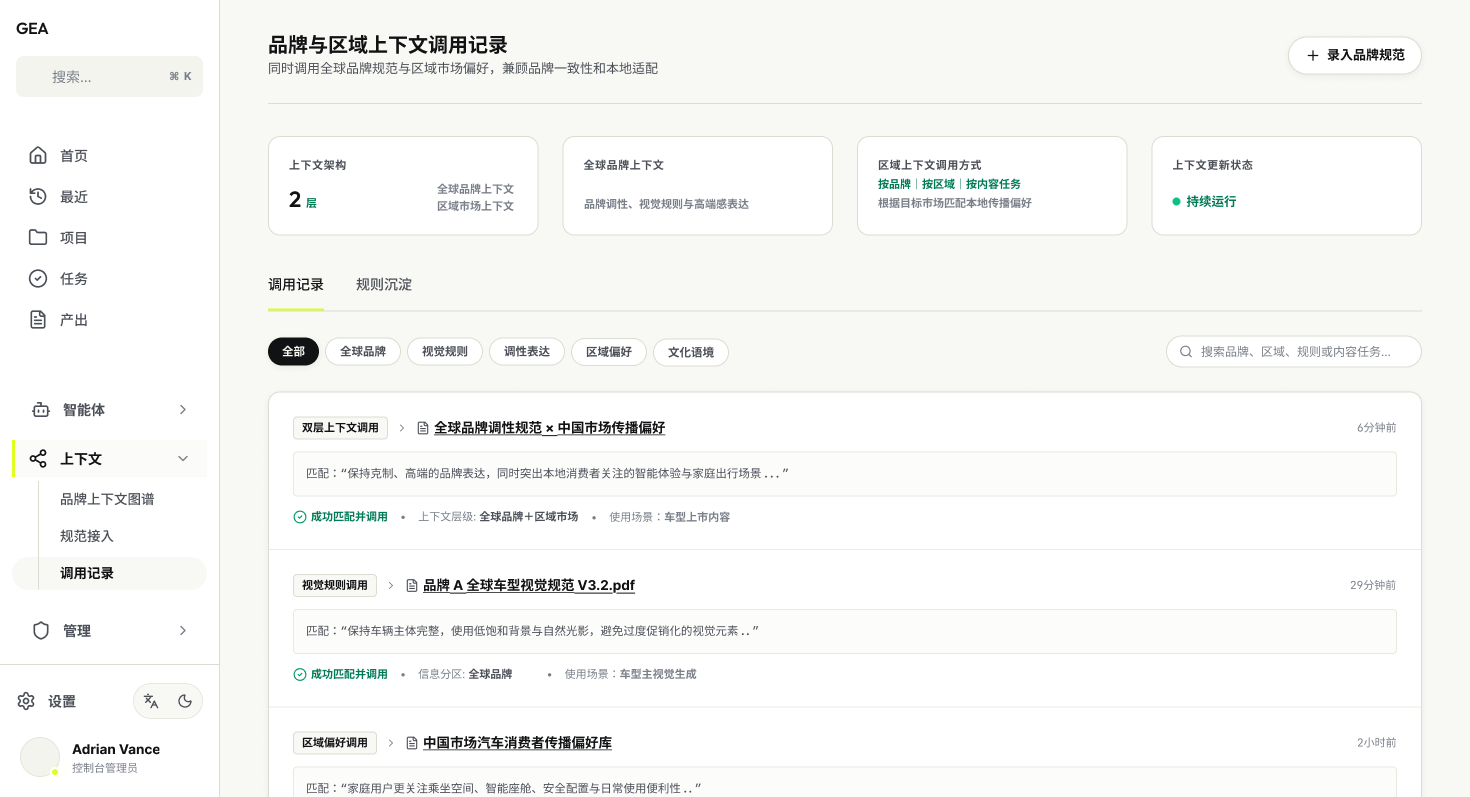
Passenger vehicle brands typically need to balance global brand positioning with regional market differences. On one hand, the visual elements, design language, brand tone, and expressions of premium feel need to be consistent over the long term; on the other hand, different regional consumers focus on different aspects such as space, performance, intelligence, safety, and lifestyle. If each market produces content independently, it can lead to fragmented brand expression; if global materials are copied verbatim, it may fail to address the real needs of local users.
The Context System maintains two interrelated content contexts for each passenger vehicle brand: one set carries global brand-level visual rules, expression tones, core values, and keyword constraints, while the other records the language habits, cultural contexts, consumer preferences, and communication focuses of each regional market. When GEA generates content, it simultaneously invokes both contexts, adjusting model selling points, usage scenarios, and expression methods based on a unified brand tone. This allows brands to continuously produce locally relevant content in different markets while avoiding deviations in visual style, value propositions, and brand positioning during large-scale communication.
Continuous Tracking of Purchase Intent (Long-Horizon Agent)
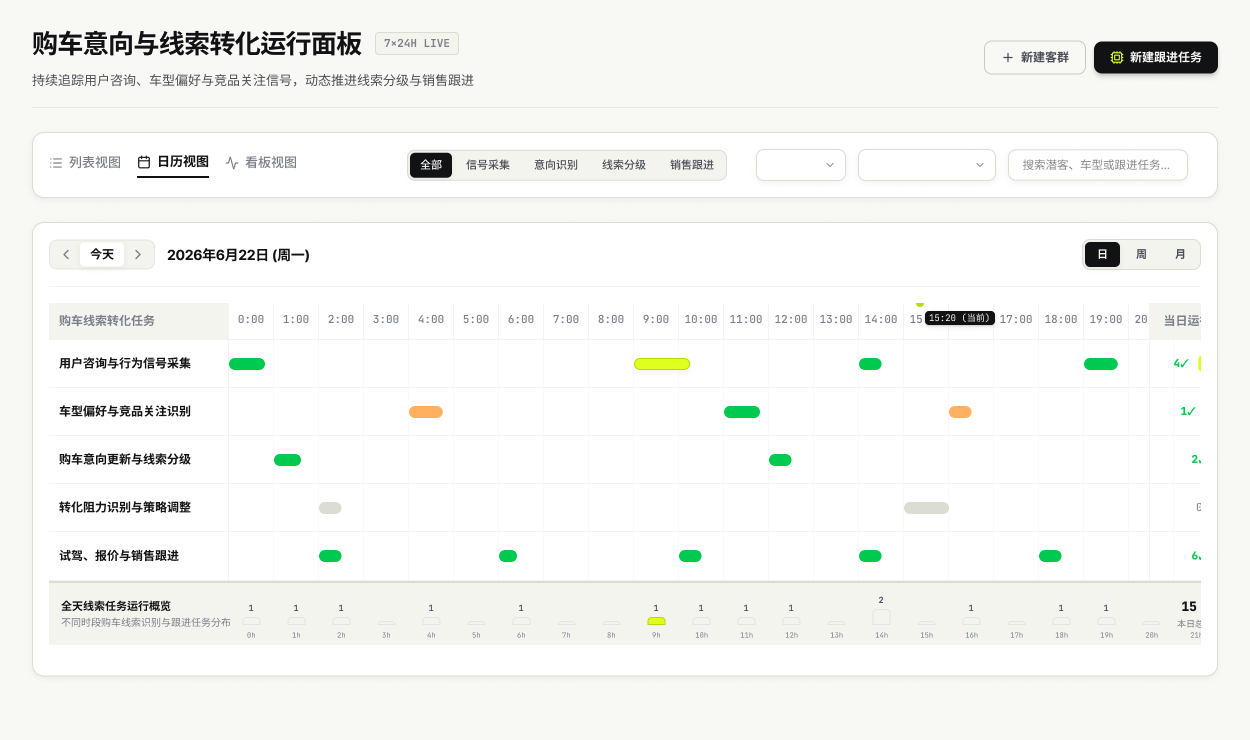
The purchase decision for passenger vehicles typically spans a long period. Potential customers may first search for model information, then compare prices, configurations, space, and competitors, and subsequently complete their judgment through online consultations, test drive appointments, or in-store communications. Traditional lead management often only records single-point actions like form submissions or phone communications, making it difficult to continuously understand how user interests change, and it can lead sales personnel to apply the same follow-up methods to all leads, missing key conversion nodes.
The Long-Horizon Agent integrates signals from historical sales paths, user inquiry semantics, model preferences, content interactions, and competitive attention to form a continuously updated purchase intent model. The system identifies whether users are more concerned about price, configuration, trade-in, financing options, or test drive experiences based on their interests and resistances at different stages, dynamically updating lead priorities and subsequent action suggestions. High-intent leads can promptly enter the test drive or sales follow-up process, while less mature leads continue to receive relevant content. By continuously identifying, classifying, and adjusting follow-up strategies, lead conversion efficiency in related projects improves by 30%.
AI Engine Brand Visibility Optimization
More and more consumers are starting to use generative AI to learn about models, compare configurations, and obtain purchase suggestions. Unlike traditional search results, AI typically synthesizes multiple information sources to form direct answers. If a brand's model information is scattered, key facts are inconsistently stated, or there is a lack of content that can be accurately understood and cited, even if the official website has published a lot of materials, it may be difficult to enter the recommended answers that users ultimately see, thus affecting the brand's exposure in new information entry points.
GEA continuously monitors the appearance and citation of brand, model, and core selling points in generative AI search and recommendation results, identifying where the brand has visibility in user questions, which model information is easily understood, and which content themes still have gaps. Based on this, the system assists in optimizing model knowledge, Q&A content, page structure, and key fact expressions, making brand information more complete, clear, and easy to cite. When users inquire about model recommendations, configuration comparisons, family vehicles, or specific usage scenarios, the brand can enter relevant answers with more accurate product information, continuously enhancing its visibility in AI information retrieval scenarios.
Value and Effects of GEA
• 30% Increase in Lead Conversion Efficiency: Continuously tracking changes in potential customer intent and optimizing follow-up strategies helps sales teams more accurately identify and advance high-potential leads. • 400% Increase in Content Reuse Rate: Continuously consolidating brand standards, model knowledge, and efficient content structures supports rapid access across different regions and channels. • Competitive Analysis Accelerated to 48 Hours: Concentrating on organizing model positioning, product selling points, and market communication information to form structured reports for business teams. • Continuous Improvement in AI Engine Visibility: Optimizing the citation performance of product technical selling points in generative AI search and recommendation results. • Automatic Localization of Dealer Content: Automatically generating differentiated content based on the market characteristics, consumer preferences, and communication contexts of different regions.
Frequently Asked Questions (FAQ)
Q: How do automotive brands unify content expression between headquarters and various terminal dealers?
A: GEA maintains two parallel contexts for the brand through the Context System—global brand-level tonal constraints (visual rules, premium feel keywords) and local communication preferences for each regional market. After headquarters produces standard content, dealers can automatically adapt it using local contexts through GEA, eliminating the need for manual re-creation, with content reuse rates increasing by up to 400%.
Q: How does GEA help sales consultants quickly obtain competitive comparison information?
A: When competitors release new configurations or adjust prices, GEA automatically monitors competitive changes and generates structured competitive configuration comparison analysis reports within 48 hours, including core parameter comparisons, selling point differentiation analysis, and response script suggestions, helping frontline sales consultants quickly grasp competitive dynamics.
Q: How can passenger vehicle brands improve lead conversion rates through GEA?
A: The GEA long-range agent integrates historical sales paths, user inquiry semantics, and competitive attention signals to build a dynamic purchase intent model, continuously tracking each potential customer's conversion probability and key resistance nodes, automatically classifying leads and optimizing follow-up strategies, helping automotive brands achieve a 30% increase in lead conversion.
Category
Automotive
Date
2026-09-08
Read Time
6 min read
Related Recommendations
Growth of New Energy Vehicle Content: Using AI to Clarify What Users Really Care About

From Post-Verification to Endogenous Constraints, How GEA Reconstructs the Compliance Norms of This Industrial Brand's Production