All
Does Harness Have a Shelf Life of Only Six Months? Why Enterprise AI Products Can't Be One-and-Done
The core component Harness of Tezign GEA is influenced by model iteration and business scenario drift, making it impossible to be statically solidified; it belongs to a dynamic constraint space. Relying on Tezign's exclusive mechanism for dynamic updates is key to the reliable operation of enterprise AI systems.
Category
All
Date
2026-09-11
Read Time
5 min read
Technical Positioning of This Article:Harness is the constraint and guidance layer in enterprise-level intelligent systems, and is a core component of Tezign GEA's long-range intelligent agent runtime. It defines the boundaries of what the agent "can do, cannot do, and should do" in specific business scenarios. The core issue discussed in this article is: why Harness must be dynamically constructed and continuously maintained, rather than being set in stone at the project kickoff. If your team is deploying an enterprise-level AI system or evaluating the long-term reliability of AI applications, the discussion in this article is directly related to your implementation strategy.
Harness plays a role in AI systems similar to traffic rules—it tells the model what is allowed, what is prohibited, and what is recommended in this business scenario. Engineers write a set of rules at the project kickoff, test them, go live, and then hope they remain effective indefinitely. This idea is very natural and tempting.
After all, static rules have obvious advantages: they are predictable, easy to audit, facilitate compliance management, and make it easy to trace problems. In many traditional software systems, static configurations are the optimal solution. So why doesn't this work in AI systems?
The reason lies not in the rules themselves, but in the object of the constraints imposed by Harness—the model—and the business served by the model, both of which are not static.
Harness is Not a One-Time Project
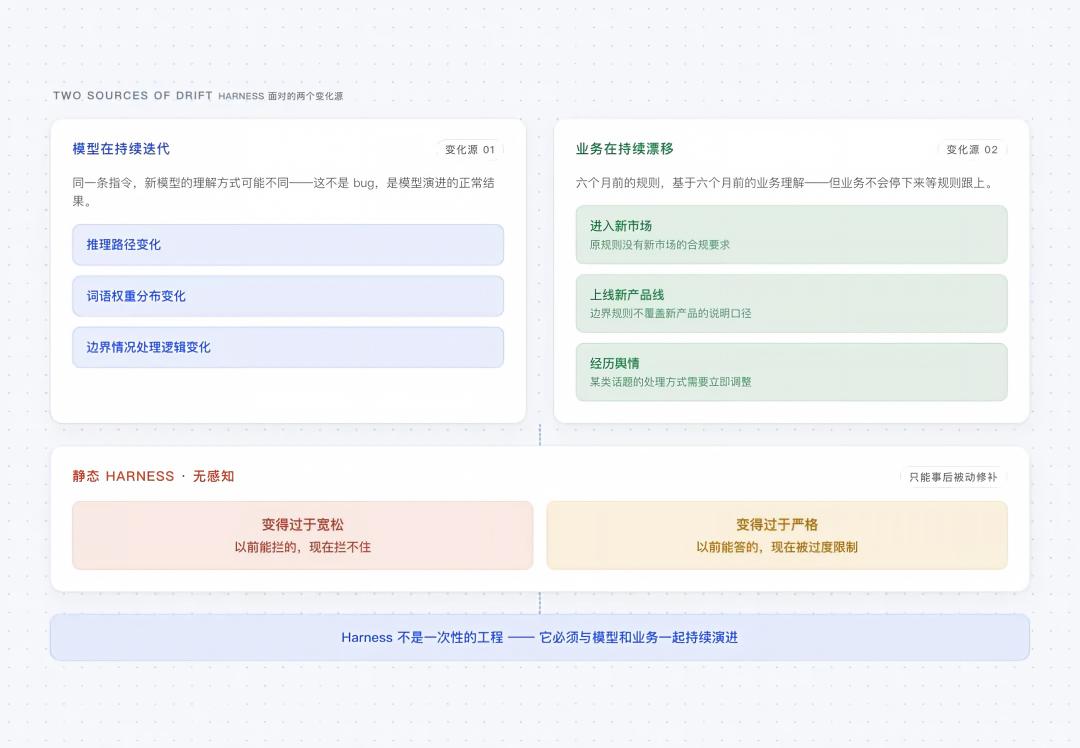
The changes that Harness faces come from two directions, either of which is enough to render static rules ineffective.
The first source of change: models are continuously iterating.
The Harness that you tested successfully on GPT-4 may not be effective on GPT-4o—not because the rules were written incorrectly, but because the new model may interpret the same instruction differently. The model's reasoning paths, the distribution of word weights, and the logic for handling edge cases can all change with version upgrades. This is not a bug; it is a normal result of model evolution.
The same Harness may become too lenient after a model update (what it used to block may no longer be blocked) or too strict (what it used to answer normally may now be overly restricted). Static Harness cannot perceive these changes and can only passively patch itself when problems arise.
The second source of change: business scenarios are continuously drifting.
Enterprise products are iterating, marketing strategies are adjusting, regulatory environments are changing, and competitive landscapes are evolving. The Harness rules written six months ago were based on the business understanding at that time. But business does not stop to wait for the rules to catch up.
A consumer goods company just entered a new market, and the original Harness did not include compliance requirements for this market; a financial institution launched a new product line, and the original boundary rules did not cover the new product's explanatory standards; a brand experienced public opinion and needed to immediately adjust its handling of certain topics—each of these situations is beyond the perception of static Harness.
What Exactly is Harness? It is Not a Set of Rules, But a Constraint Space
To understand why Harness must be dynamic, one must first understand its essence.
Harness is not a list of rules, but a definition of a constraint space. It describes the range within which the model's behavior should fall in this business context. This range is not a fixed coordinate but a boundary that changes with the context.
A more accurate metaphor is that Harness is more like an organization's values and behavioral guidelines, rather than a static permissions table. Values are continuously reinterpreted and articulated as the organization grows and the environment changes; behavioral guidelines are continuously supplemented and revised as new situations arise. Only the core principles are fixed; the specific boundaries are alive.
Static Harness is not safety; it is an illusion of safety. It gives you a false confidence of "already set guardrails" while allowing real risks to accumulate in places you cannot see.
How Does Harness Function in Tezign GEA?
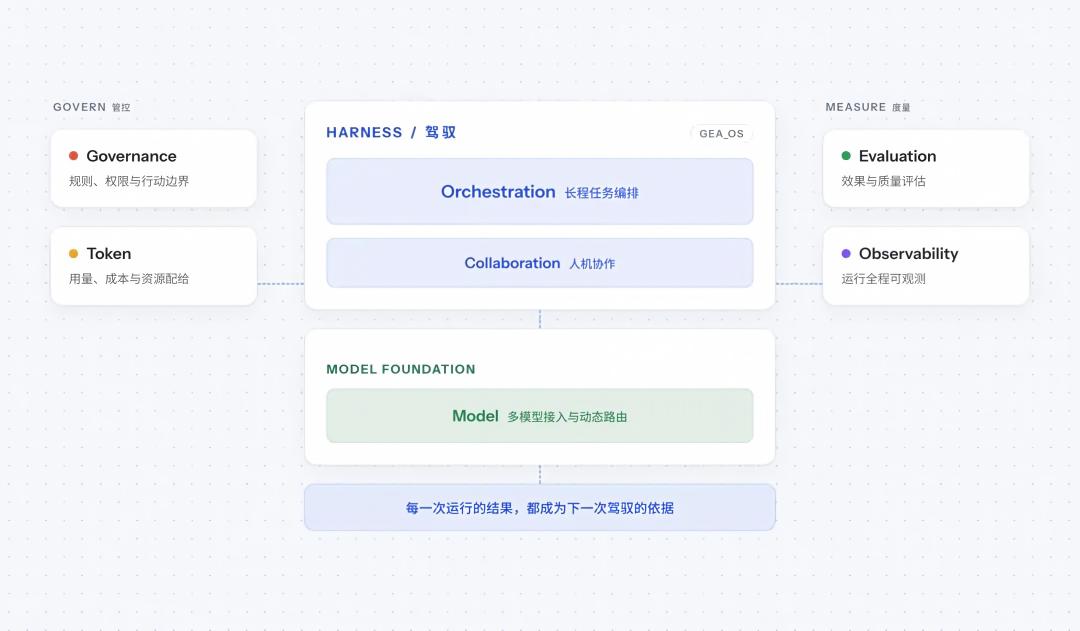
Tezign has designed Harness in the GEA long-range intelligent agent runtime to be a dynamic component deeply coupled with the Context System, rather than an independent static configuration file.
This means several specific mechanisms:
Harness updates with Context. When the enterprise's brand specifications, compliance requirements, and business strategies change and are written into the Context System, the constraint space of Harness will adjust accordingly. There is no need for engineers to manually change the rules; the changes in Context themselves drive the evolution of Harness.
Harness automatically verifies with model versions. When the underlying model is updated, the GEA runtime will re-validate key constraint scenarios, identify rule drift, and prompt boundary changes that require manual confirmation, rather than silently allowing old rules to become ineffective.
The effectiveness of Harness is observable. GEA continuously records the alignment between agent behavior and the definitions of Harness, bringing abnormal behaviors to light. Harness is not a black box that disappears into the background after deployment; it is a living system that can be continuously audited and adjusted.
Practical Implications for Enterprise AI Implementation
Understanding the dynamic nature of Harness has three direct implications for enterprises evaluating and deploying AI systems:
First, the maintenance cost of Harness should be included in the total cost of ownership. It is not enough to only calculate deployment costs; ongoing maintenance costs must also be considered. A set of static Harness may seem cheap in the short term, but in the long term, it is a hidden debt.
Second, when evaluating AI vendors, be sure to ask about the Harness update mechanism. How are the rules updated when the business changes? Who updates them? What is the update cycle? If the answer is "submit a ticket and wait for engineers to handle it," the responsiveness of this AI system is likely to lag behind your business pace.
Third, model upgrades should not only focus on capability improvements but also verify the effectiveness of Harness simultaneously. Each time the underlying model is updated, it represents a potential risk point for Harness failure. A model upgrade plan that does not cover this verification is incomplete.
Harness has never been a one-time project; it is one of the core capabilities for the continuous operation of enterprise AI systems. Getting it right is a prerequisite for reliable AI operation in real business.
Category
All
Date
2026-09-11
Read Time
5 min read
Related Recommendations

What Does AI Rely On to Determine 'This Reasoning Path is Correct' When Performing Reasoning Tasks?

How Can Long-Term Intelligent Agents in Enterprises Maintain Trust in Production Environments?