- Category
- Topic Series
- Published
- Nov 19, 2026
- Status
- On demand
- Duration
- 98 min
About this session
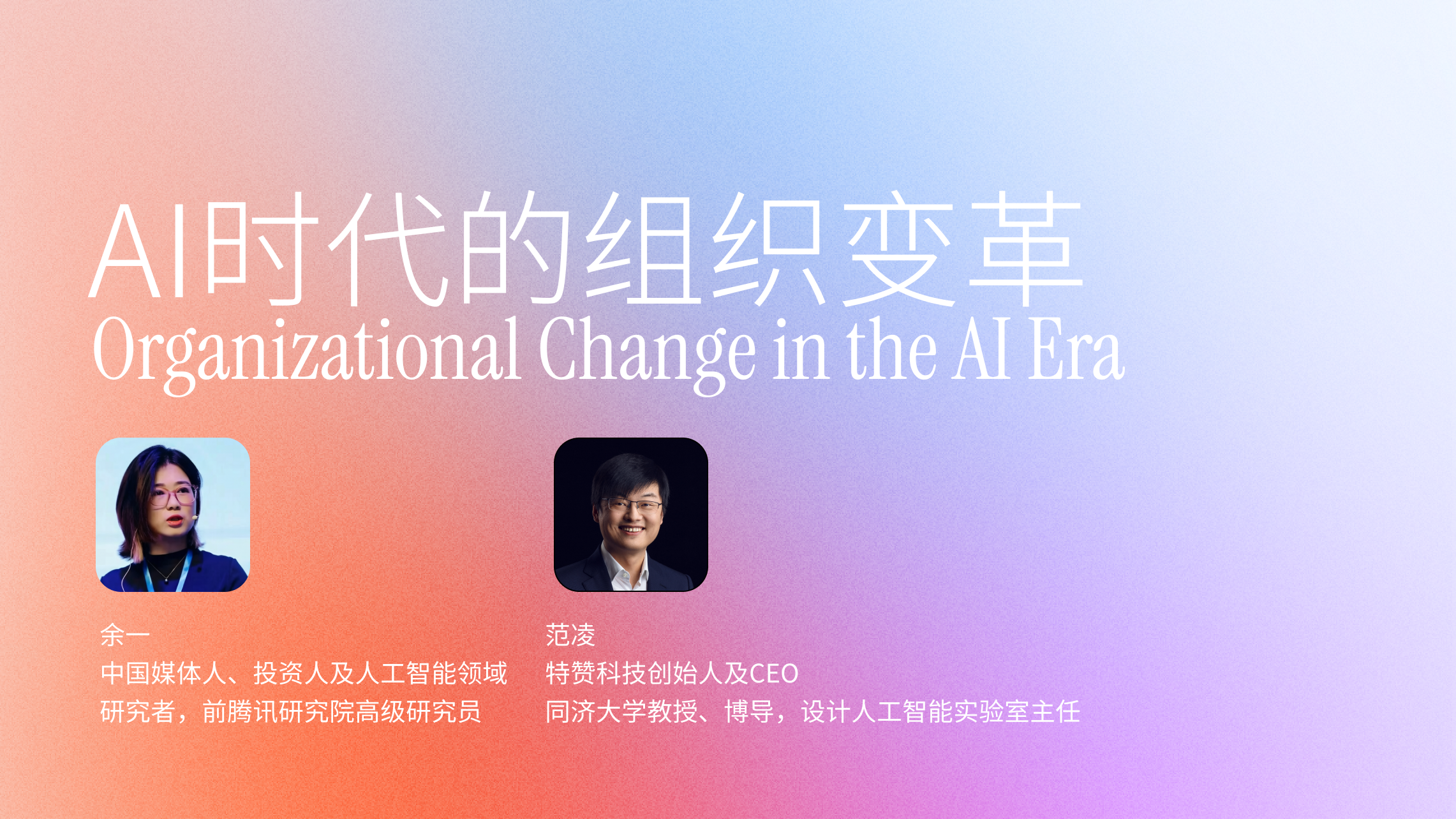
This episode of Business Becomes an Agentic Transformation mainly discusses why companies cannot stop at "using AI to improve efficiency" and must further think about how to become truly AI-native organizations. The course points out that while using AI in isolated cases can improve the speed of writing, R&D, research, and proposal generation, if organizational processes, knowledge accumulation, and decision-making methods are not restructured at the same time, efficiency gains will not automatically translate into growth. Around this issue, the course presents two key judgments: first, companies need to continuously understand users through a "subjective world model"; second, they need to continuously accumulate organizational context through an "enterprise world model," enabling agents to participate in perception, planning, co-creation, and feedback loops. For business practice, the value of this course lies in moving AI from a single-tool perspective to an operating-system perspective, making it suitable for teams thinking about product innovation, user research, organizational upgrading, and the building of intelligent sovereignty.
The real leap for companies is from AI efficiency gains to AI-native
When employees use AI individually to write proposals, perform analysis, run processes, and so on, it only means the organization has entered the AI enablement stage; it does not mean the company has completed an AI-native transformation. Real change happens only after processes, division of labor, knowledge accumulation, and production relationships are all redesigned around AI, which is also the key prerequisite for turning local efficiency into overall growth.
Understanding users requires shifting from data analysis to simulating human judgment
Companies should not rely solely on traditional research and structured data to understand users; instead, they should use a subjective world model to simulate real people's expression, narrative, cognition, and behavior. The value of this approach is not to replace all research, but to help companies understand complex, contradictory, and changing user judgments more continuously, providing new methods for product testing, marketing validation, and consumer research.
Understanding the company itself also requires a world model
The bottleneck in enterprise AI transformation is often not model capability, but the fact that key experience, judgment, and processes still remain in people's heads and have not been turned into context that can be continuously accessed. The significance of an enterprise world model is to continuously accumulate the organization's explicit knowledge and implicit judgments, enabling enterprise-level agents to have a reusable, feedback-driven, and evolvable contextual foundation.
The value of agents is not only automation, but also creating new tasks
The significance of agents is not just replacing existing work, but helping companies discover new needs more frequently, propose new solutions, and form new ways of collaboration. In other words, the value of AI is not only reflected in saving time, but also in creating new product opportunities, operational actions, and growth space.
Intelligent sovereignty determines whether a company can accumulate long-term compounding returns
What companies truly need to master is not merely the right to call underlying models, but control over context, evaluation criteria, action boundaries, and transferability. Only when these capabilities are accumulated as the company's own assets can the efficiency brought by AI further translate into long-term compounding returns rather than a one-time tool dividend.
What you will learn
- 01Why do cross-department handoffs still get stuck even though every role is more efficient?
- 02As user data keeps piling up, do you really understand why users choose?
- 03If model companies raise prices or shut down, can your AI capabilities go with you?
- 04AI doesn't just wait for your questions; it also proactively senses change and drives business forward
- 05Hand the 0 to 70 out of 100 work to AI, and let people focus on creating beyond 100