Product Updates
Capability Development Agent: Ensuring Continuous Growth of Organizational Capabilities
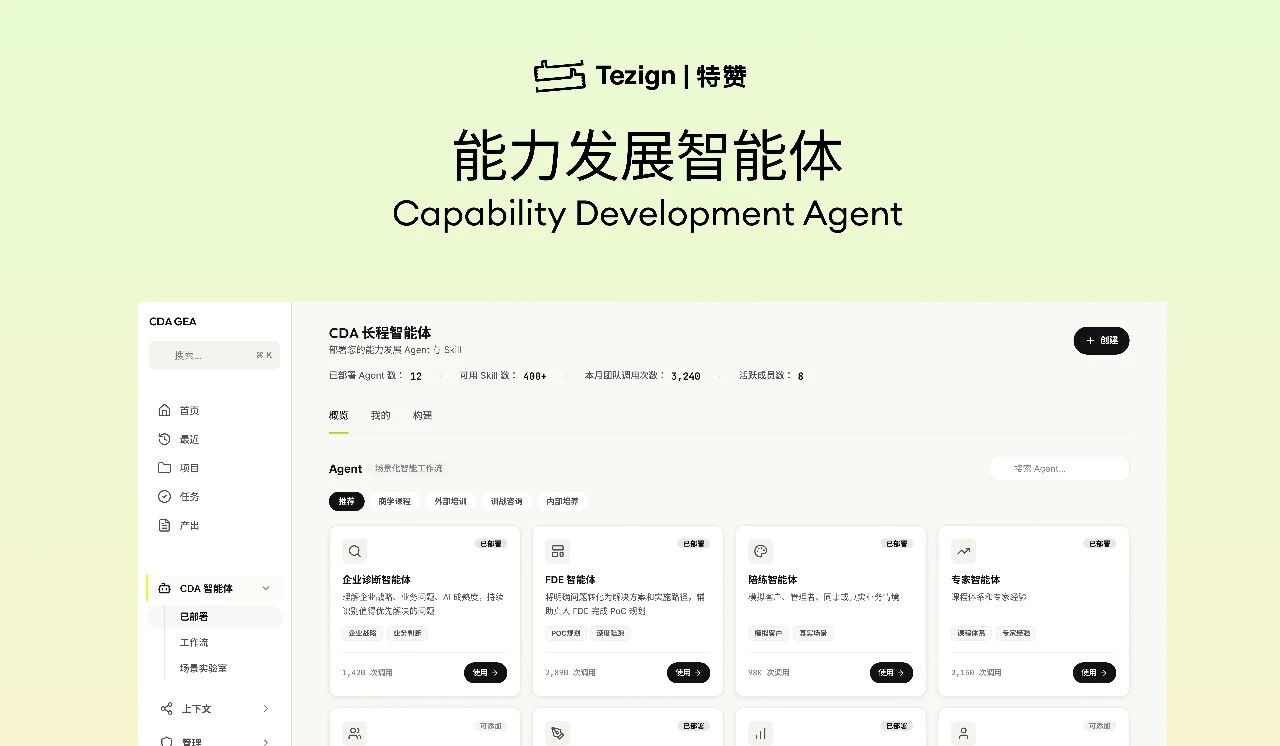
Tezign has built the Capability Development Agent (CDA) based on GEA, targeting both internal and external learning scenarios for enterprises, upgrading from delivering courses to being responsible for capability outcomes, providing a long-term, continuous capability growth system.
Category
Product Updates
Date
2026-08-25
Read Time
7 min read
[GEA Long-Horizon Agent] Series
The Capability Development Agent is a long-horizon agent specifically designed to drive organizational capability development. It belongs to the solution-level long-horizon agents within Tezign GEA architecture. These long-horizon agents operate on top of the GEA architecture, refined from best practices serving hundreds of enterprise clients; they are not passive functions waiting for instructions but proactive long-horizon agents capable of independently completing entire categories of tasks.
An executive team from a manufacturing company participated in an AI boot camp. After three days of courses, they clearly remembered the instructor's framework, but upon returning to the company, the first question stumped them: Where do we start?
This is not an isolated phenomenon. Enterprises invest heavily in organizational learning every year—business school courses, external training, consulting, internal development programs—but capability changes occur in the workplace, not in the classroom. There is a lack of a continuous connection mechanism between learning and work: courses end, consultants leave, context resets to zero, and the next phase starts from scratch.
Capability development is not a problem that can be solved by a single course; it is a long-term process that requires continuous perception and adjustment.
What is the Capability Development Agent
Capability Development Agent, CDA
Tezign has built the Capability Development Agent (CDA) for organizational learning scenarios—a long-term solution based on GEA 企业级智能体系统, primarily targeting two types of scenarios:
External Learning Services (business education, corporate training, consulting, etc.): Upgrading course services from "delivering content" to "being responsible for results," extending learning effectiveness beyond the classroom.
Internal Capability Development (onboarding, product training, sales practice, management training, etc.): Building a continuously operating capability growth system within the enterprise, independent of single training activities.
It is not a knowledge assistant that answers questions but is long-term responsible for the capability development outcomes of an individual, team, or enterprise.
How does it work?
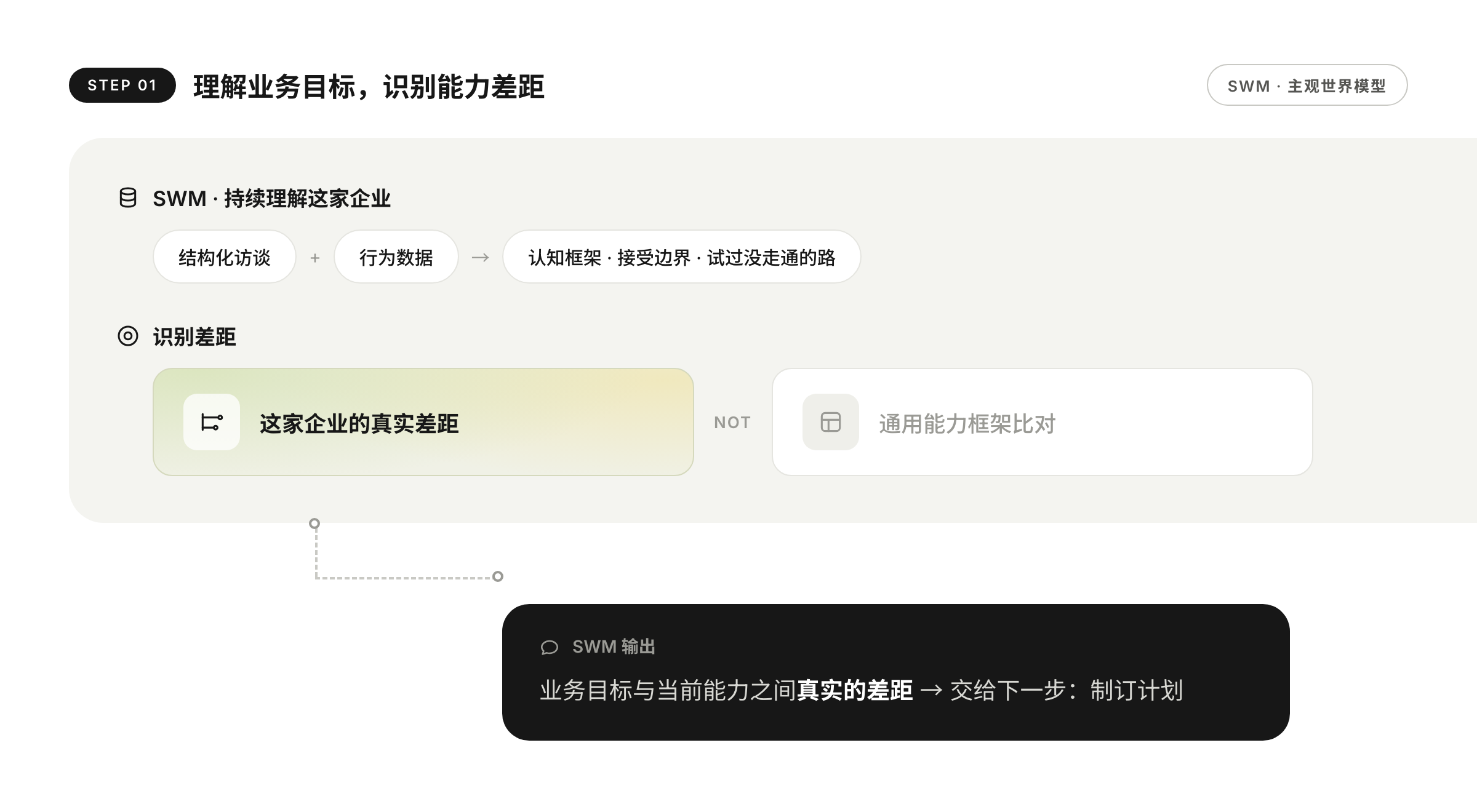
Step 1: Understand Business Goals and Identify Capability Gaps
The system first establishes a continuous understanding of the enterprise (or individual). Through AI Interviews, it obtains structured interviews and behavioral data, modeling the manager's cognitive framework, the team's acceptance boundaries, and historical attempts that did not succeed—this is not about industry labels but the specific decision logic and capability situation of this enterprise. Based on this, the Enterprise Diagnosis Agent identifies the real gap between business goals and current capabilities, determining which scenarios are prioritized for investment.
Step 2: Develop a Plan and Schedule Multi-Agent Collaboration
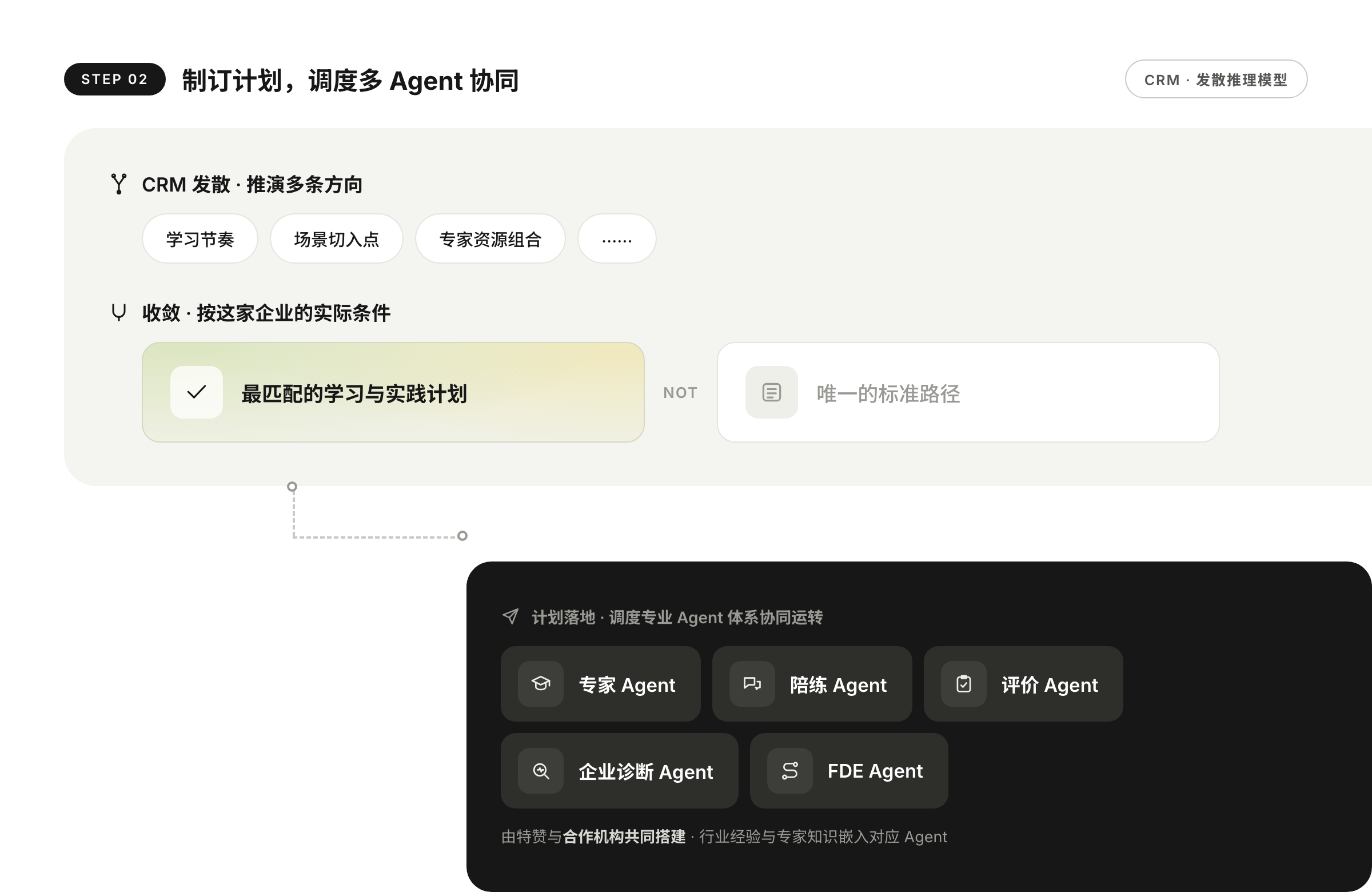
With the identification of capability gaps, the CRM (Creative Reasoning Model) formulates a personalized learning and practice plan. The CRM does not provide a single standard path but first simulates multiple possible directions—different learning paces, different scenario entry points, different combinations of expert resources—then converges to the most suitable solution based on the actual conditions of the enterprise.
Once the plan is implemented, the system schedules a set of professional agent systems to operate collaboratively, including:
Expert Agent: Carries professional course systems and expert experience, providing explanations, answering questions, and offering suggestions to learners within the authorized scope, ensuring that the consultant's knowledge does not reset to zero after the project ends.
Practice Agent: Simulates clients, managers, colleagues, or real business scenarios, supporting repeated practice to turn knowledge into behavior.
Evaluation Agent: Evaluates dialogues, assignments, and work performance according to clear standards, providing improvement suggestions.
Enterprise Diagnosis Agent: Understands enterprise strategy, business issues, and AI maturity, continuously identifying priority problems to solve.
FDE Agent: When the enterprise enters a deep transformation phase, it converts clear problems into solutions and implementation paths, assisting real FDE in completing PoC planning.
This multi-agent system is not built solely by Tezign—our network of partner institutions deeply participates in system construction from a third-party professional perspective, embedding industry experience and expert knowledge into corresponding agents, making system judgments more credible and services more aligned with industry realities.
Step 3: Observe Performance, Continuously Adjust, Extend to Transformation Projects
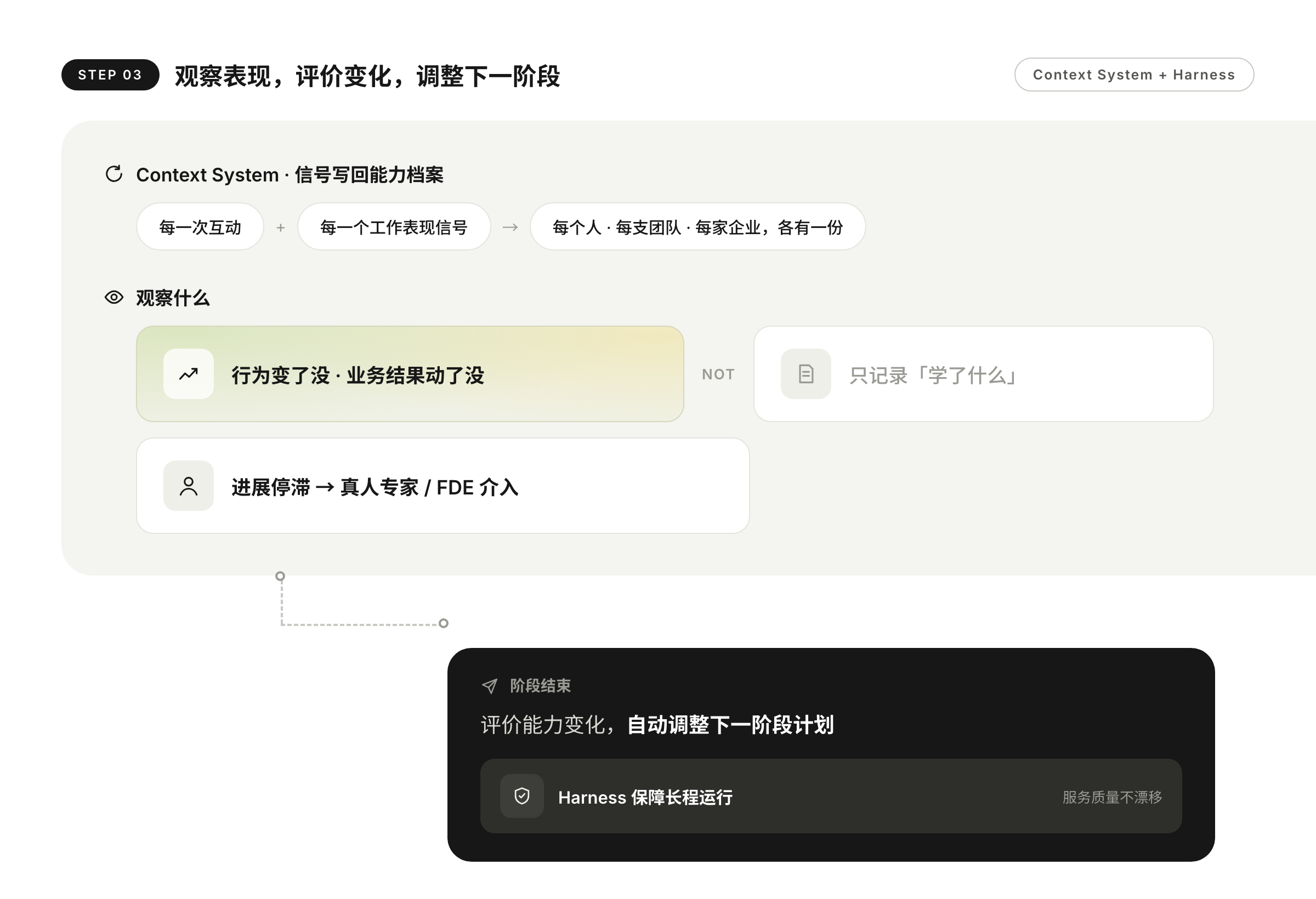
During the learning process, every interaction and every work performance signal is written back to the Context System, continuously enriching the capability profile. The system not only records "what was learned" but also observes "whether behavior has changed and whether business results have shifted."
If progress stagnates, the system introduces real experts or FDE intervention; at the end of the phase, based on the accumulated complete context, it evaluates capability changes and automatically adjusts the next phase plan.
If the enterprise diagnosis identifies deeper transformation needs—not just learning, but a specific business process that needs reconstruction—the system naturally connects to enterprise transformation projects, extending from training all the way to diagnosis, solutions, and implementation. The entire service chain does not require re-transfer of context, as the system's understanding of this enterprise has accumulated throughout the entire cooperation cycle.
The entire process is supported by the Harness engineering layer to ensure stable operation—defining what the system can autonomously decide at each node, when human judgment is needed, and incorporating an Eval-driven assessment mechanism to ensure service quality does not drift during long-term operation.
What are the core differences compared to ordinary AI learning tools?
Knowledge bases, AI Q&A, and online course platforms can answer your questions, but they do not understand your organization—every conversation starts anew, with no accumulation, and the system does not care whether capability changes occur.
The difference of the Capability Development Agent is that it is a Long-Horizon Agent: the Context System accumulates every interaction and work performance, SWM continuously models the capability status of each person and team, and CRM handles judgments like "what's the next step" that do not have standard answers. The three-layer collaboration allows the system to understand this enterprise, this team, and this person better with each use.
Capability growth no longer relies on a single course or a specific consultant but is sustained by the system's continuous operation.
The Capability Development Agent is backed by the GEA infrastructure and application capabilities provided by Tezign, combined with the industry expertise of partner institutions, forming a complete system through three layers: enterprises do not just gain an AI tool, but a capability development system that is backed by industry knowledge, can operate continuously, and understands this enterprise better the more it is used.
"Weixi is one of the first partner institutions of the Capability Development Agent. We embed our course systems, expert resources, and understanding of corporate clients into this system, allowing every enterprise participating in our courses to have a mechanism to truly apply what they have learned after the course ends. This makes enterprise growth a continuous, iteratively improving system." — Weixi Course Leader. (Weixi is a leading business consulting firm in China)
Who is suitable for use?
Within the enterprise—
HR / Training and Talent Development Leaders (L&D, TD): Significant annual training budgets, but only able to report on course hours, completion rates, and satisfaction, unable to clarify whether behavior has actually changed.
Business Team Leaders: New hires take time to ramp up, product updates are too fast for the team to keep up, and onboarding relies entirely on individual initiative—capability issues directly hinder business metrics.
Management Training Leaders: Training programs are conducted in phases, but each phase resets to zero, with no visible growth trajectory for individuals across phases.
Executives / Transformation Leaders: Aware of the gap between organizational capabilities and business goals, but lack a mechanism that can operate continuously, rather than relying on a one-time project sprint.
In learning service institutions (business schools, corporate training companies, consulting firms)—
Course Product Leaders: Courses have a good reputation, but clients always ask, "What happens after the course?" The service ends at the conclusion of the course.
Delivery and Customer Success Leaders: Want to be accountable for learning outcomes, but have no mechanisms left with clients after consultants leave, and renewals rely solely on relationship maintenance.
Founders / Business Leaders: Want to upgrade services from "selling course hours" to "result-oriented collaboration," but lack a system to support long-cycle services.
We offer two cooperation models
External Learning Service Institutions: Business schools, corporate training companies, consulting firms—upgrading services from "course delivery" to "result responsibility," extending client service cycles, improving renewal rates and reputation.
Internal Capability Development for Enterprises: Accelerating onboarding, product knowledge training, enhancing professional skills, management training—ensuring that every development path continues to operate without increasing HR manpower.
The Capability Development Agent is currently open to enterprises through a network of partner institutions. Tezign is continuously expanding the scenarios covered, including core tracks for AI transformation in manufacturing, consumer goods, professional services, and more.
Category
Product Updates
Date
2026-08-25
Read Time
7 min read
Related Recommendations

Tezign E-commerce Content Growth Service: No More Material Shortages or Gambling

Tezign Model Hub: A Platform for Divergent Reasoning and Multi-Model Orchestration - Transforming Model Governance from Engineering Usability to Business Manageability