Product Updates
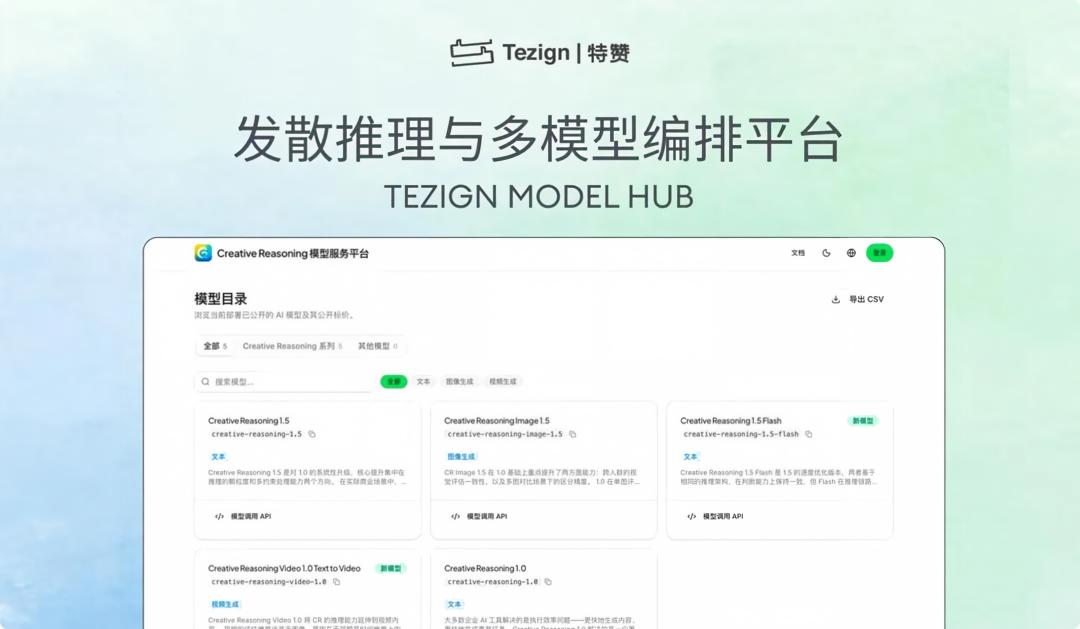
Tezign Model Hub: A Platform for Divergent Reasoning and Multi-Model Orchestration - Transforming Model Governance from Engineering Usability to Business Manageability
Enterprise AI is often procured in a decentralized manner by business teams, with robust engineering monitoring but lacking governance at the business level. Tezign Model Hub relies on a unified governance foundation to provide divergent reasoning and multi-model orchestration capabilities, enabling phased implementation of AI business manageability.
Category
Product Updates
Date
2026-09-08
Read Time
8 min read
Most enterprises begin their AI procurement from various business teams.
The marketing team takes one, the product team takes one, the R&D team takes one; some use cloud platforms, some directly call APIs, and some are deployed locally. The CTO and CIO teams usually have established solid engineering monitoring—metrics like call volume, latency, and availability are visible. However, when the question shifts from 'Is the system stable?' to 'What is the relationship between investment and business output?', it becomes necessary to answer: How many models are we currently using, how much are we spending each month, and what do we get in return?
This is not about any particular company doing poorly. This is a new governance challenge that every enterprise faces as AI moves from pilot projects to large-scale implementation—there is still a gap between engineering usability and business manageability.
After Scaling AI, the Focus of Governance Changes
Model invocation becomes complex, not due to poor management, but because each decision made at the time of integration was reasonable for the business context.
Business teams choose models based on whether they can accomplish the current task. Using GPT-4 for content generation, Claude for analysis, and open-source models for classification—each choice is optimal in its local context. But when these choices accumulate at the enterprise level, engineering monitoring struggles to answer business-level questions: What is the relationship between this bill and business output, are the quality standards for different tasks consistent, and are the data invocation boundaries adhered to in every call?
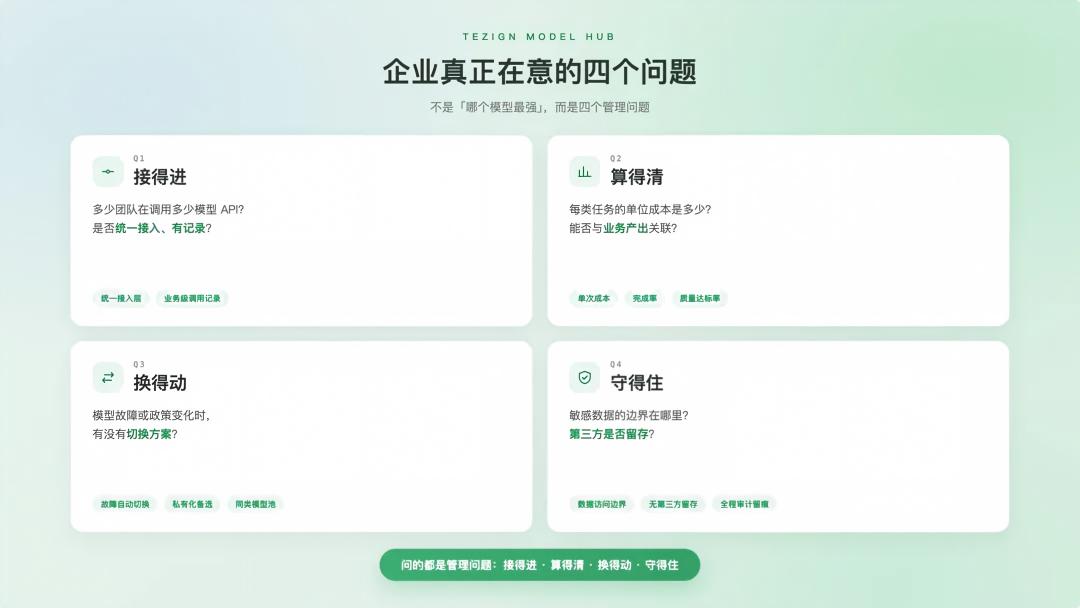
What enterprises truly care about is not 'Which model is the strongest?' but:
- How many teams are currently calling how many models' APIs, and is there a unified access record?
- What is the unit cost for each type of task, and is there a correlation with business output?
- If a model service fails or policies change, is there a switch plan?
- Has the enterprise's sensitive data crossed the necessary boundaries, and is it retained by third parties?
These four questions form the foundation of model governance.
The Governance Foundation Precedes Capability Selection
A common decision-making inertia is: first assess which model is the strongest, then decide which to use.
However, before a business-level governance system is established, this assessment lacks a business dimension for reference. Model A is stronger than Model B in what tasks, measured by what quality standards, and what are the cost boundaries—if there is no unified business data foundation, the assessment can only remain at the technical indicator level, making it difficult to link to business results.
The design starting point of Model Hub is to layer business perspective governance on top of the existing engineering system, and then optimize capability selection based on this foundation.
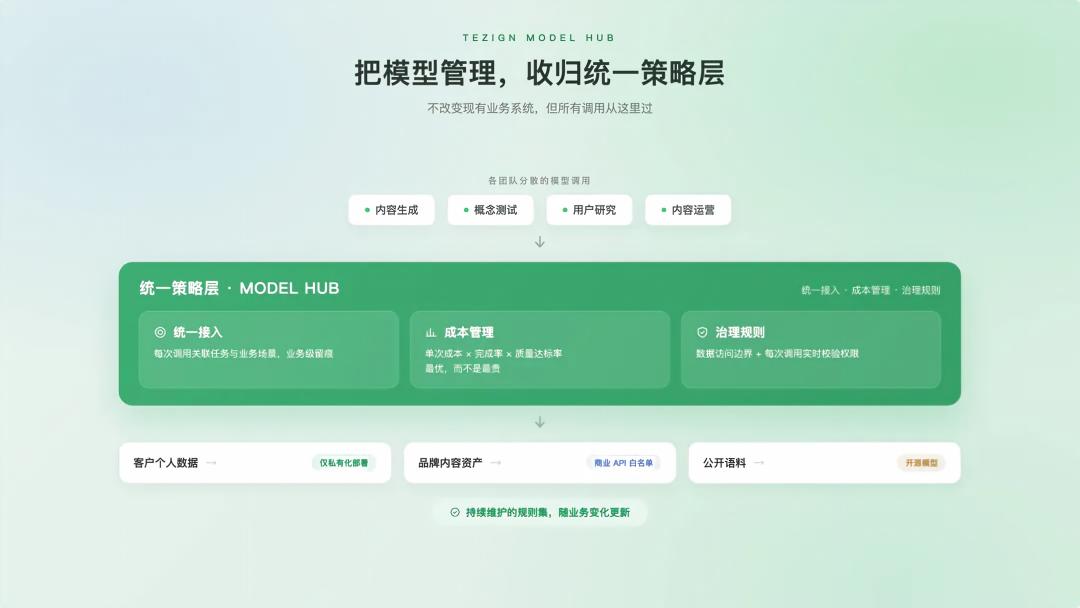
Unified Access Layer: Aggregates the dispersed model calls from various teams into a unified access point, without changing existing business systems, but all calls pass through here, forming a complete business-level call record.
Cost Management: Associates model invocation costs with task types. It’s not about looking at the total bill, but rather examining 'What is the cost per invocation for this type of task, what is the completion rate, and what is the quality compliance rate?' Only by putting these three numbers together can one determine whether the current model configuration is optimal, rather than just the most expensive. During business scale expansion, cost structure is often the first area to go out of control—unified token cost allocation, departmental/application-level budget control, and task-level cost and quality correlation views make every cent of AI budget visible, traceable, and optimizable.
Governance Rules: Set different model access boundaries for different types of data, and combine permission-aware retrieval to verify data permissions in real-time during each invocation. Which types of data can only go through private deployment, which can go through commercial APIs, and which can use open-source models—this is not a one-time configuration but a set of rules that are continuously maintained as business changes.
Tezign Model Hub's Two Core Capabilities: Divergent Reasoning + Multi-Model Orchestration
Governance addresses control issues. Once control is in place, Tezign provides two native business capabilities on Model Hub—no additional procurement is needed, and GEA does not need to be pre-deployed; it can be called directly.
Divergent Reasoning: Allowing for More Possibilities in Business Judgments
Tezign's self-developed Creative Reasoning Model (CRM) is the first large model in China that prioritizes divergence and has completed large model filing.
Business and social issues are often "wicked problems" with no standard answers.—H.W.J. Rittel, M.M. Webber
When general large models handle business judgment tasks, they face a structural limitation: their reasoning architecture is convergent reasoning, which approaches a unique optimal solution for a given problem. This is effective for mathematics, code, and logic, but business judgments—new product directions, growth paths, brand strategies—do not have a single correct answer and require divergent reasoning: first expanding and comparing multiple substantively different paths, then making a convergent choice.
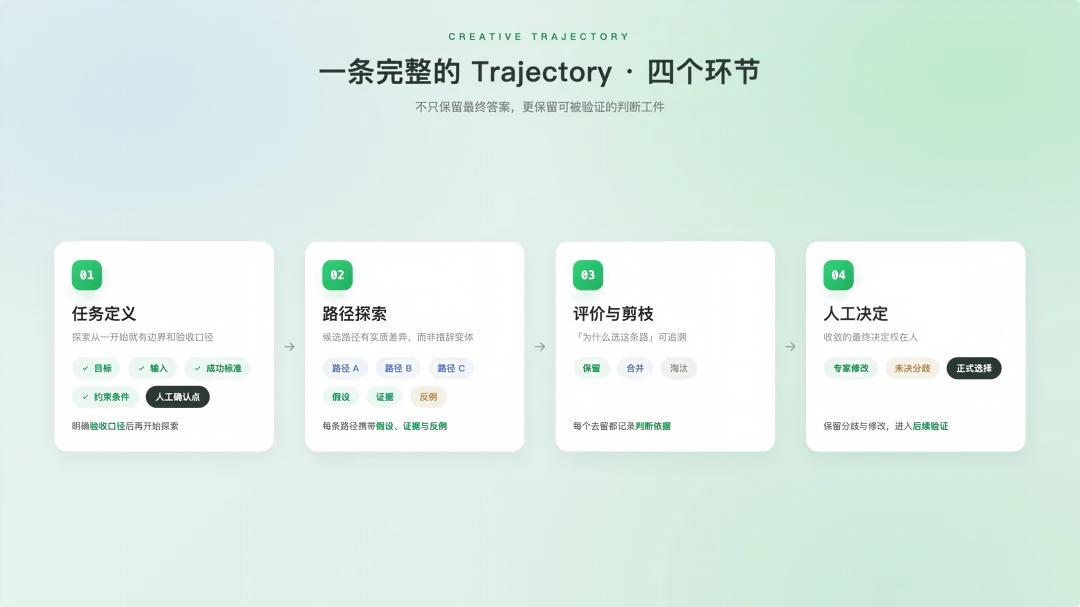
What CRM does is not stronger convergence, but structured divergence: Based on a tree-like thinking chain, it expands multiple reasoning paths for the same business problem along different assumptions and constraints, recording the basis for advancing each path, constraint checks, and reasons for elimination, ultimately outputting a decision trajectory artifact that can be compared and reviewed—Creative Trajectory.
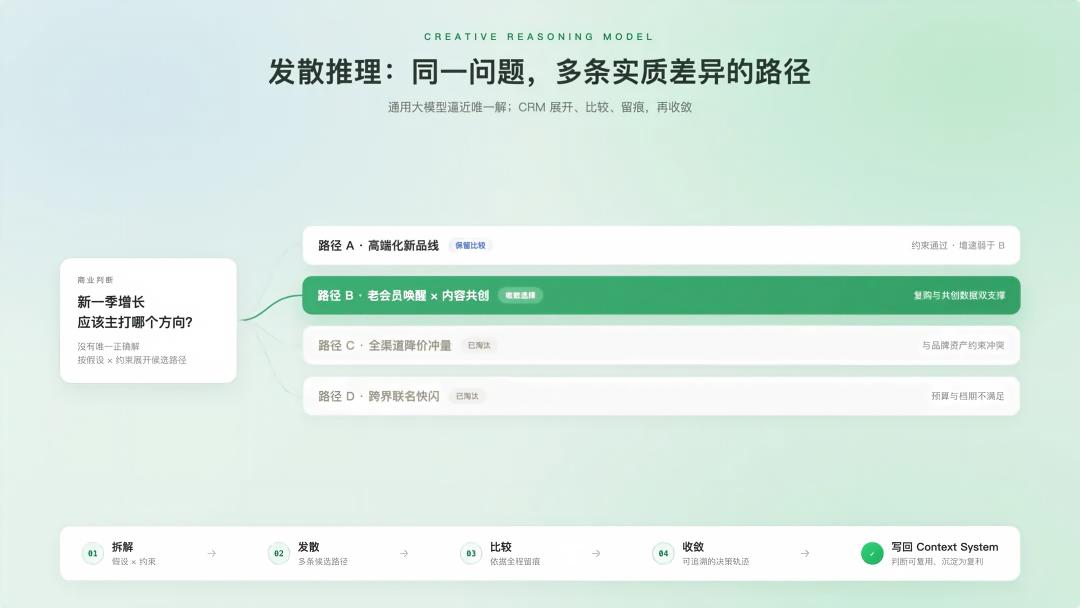
Trajectory organizes the entire process of task definition, candidate paths, evidence, evaluation, pruning, and human decisions, consisting of four stages:
1. Task Definition—Clarifying goals, inputs, success criteria, constraints, and human confirmation points.
2. Path Exploration—Generating candidate paths that have substantive differences, each carrying assumptions and counterexamples.
3. Evaluation and Pruning—Recording which paths are retained, merged, or eliminated, along with the judgment basis behind them.
4. Human Decision—Retaining expert modifications, unresolved differences, and formal choices, ensuring that humans always hold the final decision-making power for convergence.
The judgment process and decision trajectory (Trajectory) are embedded in the enterprise context system, so that when similar problems arise next time, the comparison basis for each path from the last time is available, creating a compounding effect of 'becoming smarter with use.'
Multi-Model Orchestration: Matching the Most Suitable Model for Each Task
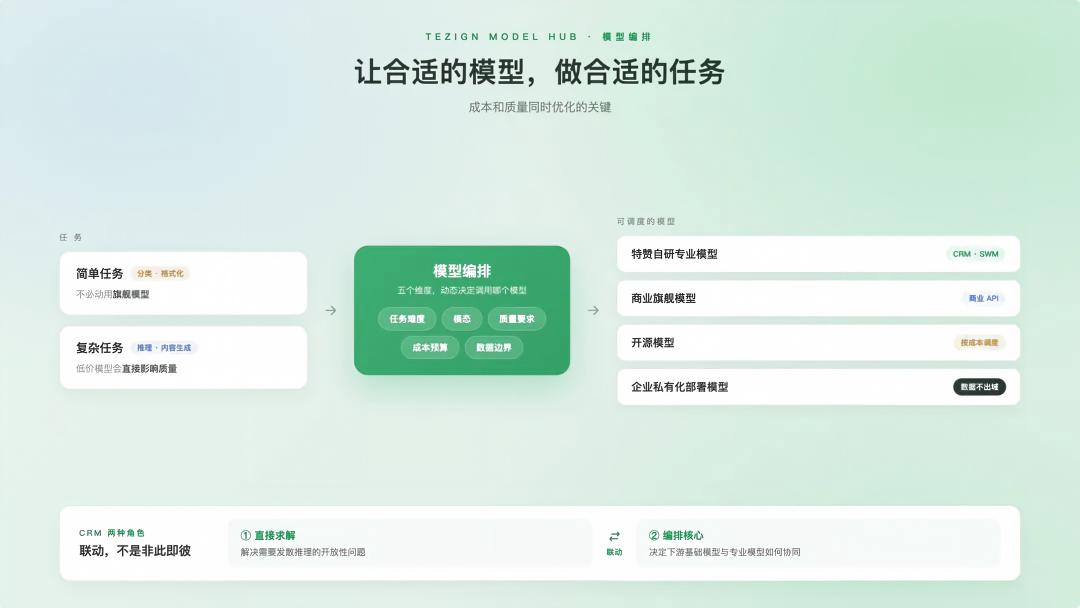
Different tasks have different requirements for models. Simple classification and formatting tasks do not require flagship models; complex reasoning and content generation tasks will directly affect quality if low-cost models are used. Matching the right model to the right task is key to optimizing both cost and quality.
The model orchestration capability of Model Hub dynamically decides which model to invoke based on task difficulty, modality, quality requirements, cost budget, and data boundaries—this can include Tezign's self-developed professional models, commercial flagship models, open-source models, or models deployed privately by the enterprise.
In the same business context, CRM can directly solve open-ended problems requiring divergent reasoning, or it can serve as the orchestration core, determining which foundational and professional models collaborate to complete tasks—these two capabilities are interconnected, not mutually exclusive.
How Does Enterprise AI Governance Occur in Actual Business?
Decisions regarding enterprise AI governance typically do not start with 'I want to procure a platform,' but rather with 'The engineering metrics are already comprehensive, but the business results are still unclear.' This is also the frontline feedback that Tezign has learned from serving over 200 large enterprises in the past.
If your enterprise already has multiple teams calling different models, and engineering monitoring is already in place, but costs, quality, and data boundaries have not yet been integrated with business scenarios, then the integration of Model Hub is not a one-time product procurement, but rather an addition of business-level governance on top of the existing engineering system.
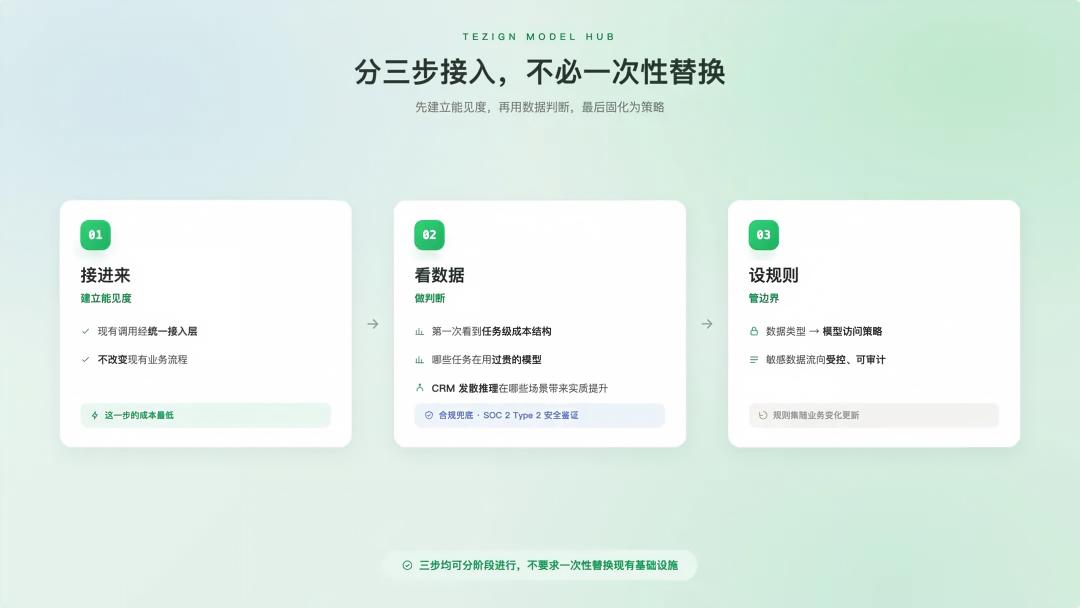
This can be broken down into three steps:
The first step is not to replace existing models, but to bring existing calls in and establish visibility. This does not change any existing business processes; it simply allows all calls to pass through a unified access layer.
The second step is to look at the data and make judgments. After unified access, for the first time, one can see the task-level cost structure—what tasks are using expensive models, which tasks have incorrectly set quality standards, and in which business judgment scenarios CRM's divergent reasoning capability can bring substantial quality improvements. Tezign's compliance detection system and SOC2 Type 2 security certification provide compliance assurance for the entire call chain.
The third step is to set rules and manage boundaries. Based on data and business needs, formulate model access strategies for different data types to ensure the flow of sensitive data is controlled.
These three steps can be done in phases, without needing to replace existing infrastructure all at once.
Two Capabilities, One Foundation
Divergent Reasoning—Answers: What paths are available for this open-ended question, and how can we converge based on evidence?
Multi-Model Orchestration—Answers: Which model (or combination of models) should be invoked for this business task?
These two capabilities are built on a foundation of unified access, cost control, quality assessment, and compliance governance, collectively forming Tezign Model Hub—a standalone platform for divergent reasoning and multi-model orchestration that supports the transition from engineering usability to business manageability.
If you are evaluating the current state of enterprise model governance or want to understand the specific path for integrating Model Hub into your existing AI infrastructure, feel free to contact Tezign to review the current model usage and bring governance and business closer together on top of existing infrastructure.
Category
Product Updates
Date
2026-09-08
Read Time
8 min read
Related Recommendations

Tezign E-commerce Content Growth Service: No More Material Shortages or Gambling

Tezign TikTok Content Growth Service: Making Brand Expansion No Longer a Gamble on Viral Hits